
I had a childhood I could never complain about. I am very grateful to have had the constancy I had, to have been always very happy and very loved. I was raised by a single mother, and it is because of her determination and dedication that my home life growing up was so secure.
We were never wealthy, but I never went without. We had lots of fun, laughter and adventure together, and my mum always found ways to work harder, and smarter, to provide for me so that I never had to worry, and I didn’t. Then, when I was in my late teens, ME came and took this ability away from my mum, and both of our lives were changed.
May 12th was International ME Day. I’ve wanted to write something about ME since I started at Gair Rhydd, but I haven’t until now because there’s so much to say and honestly, it is hard to find the words. I felt I wouldn’t judge anything I wrote good enough.
However, in hopes of getting something published to make this disabling condition even slightly more acknowledged, I have decided to let the experiences speak for themselves. I can only hope that people find them shocking enough to encourage others to become better informed. I hope that people living with ME might eventually experience a warmer and less prejudiced society, might encounter professional competence and care as standard, instead of endemic scorn and routine dismissal.
I hope they will, one day soon, feel supported rather than isolated, that they will finally be collectively believed and that they will get the help they deserve, the care any of us would expect. ME (Myalgic Encephalomyelitis) is described by Action for ME as ‘a chronic, fluctuating disease, causing symptoms such as PEM, sleep problems, problems with thinking and memory (brain fog), pain, and crushing fatigue.’ Post Exertional Malaise, they clarify, is ‘the hallmark symptom of ME and means that simple physical or mental activities, or combinations of activities, can leave people with ME feeling utterly debilitated’. The ME Association further clarify that ME is generally classified as a post-viral syndrome and neurological condition which has ‘a clearly defined diagnostic criteria produced by the National Institute for Health and Care Excellence (NICE).’ ME has been officially recognised by The World Health Organization (WHO), as a physical condition classified under diseases of the nervous system, since 1969.
Yet in 2026, the prejudice that ME ‘must be all in the head’ is still alarmingly widespread. The symptoms of ME are chronic and complex, affecting many body systems. ME is a fluctuating condition and can affect people to vastly differing degrees from those who, with careful management of symptoms (Pacing), may continue to work and enjoy some degree of social activity, to those who are unable even to think clearly, to care for themselves in the most basic ways, who are often in constant pain, immense sensory discomfort and battling against malnutrition.
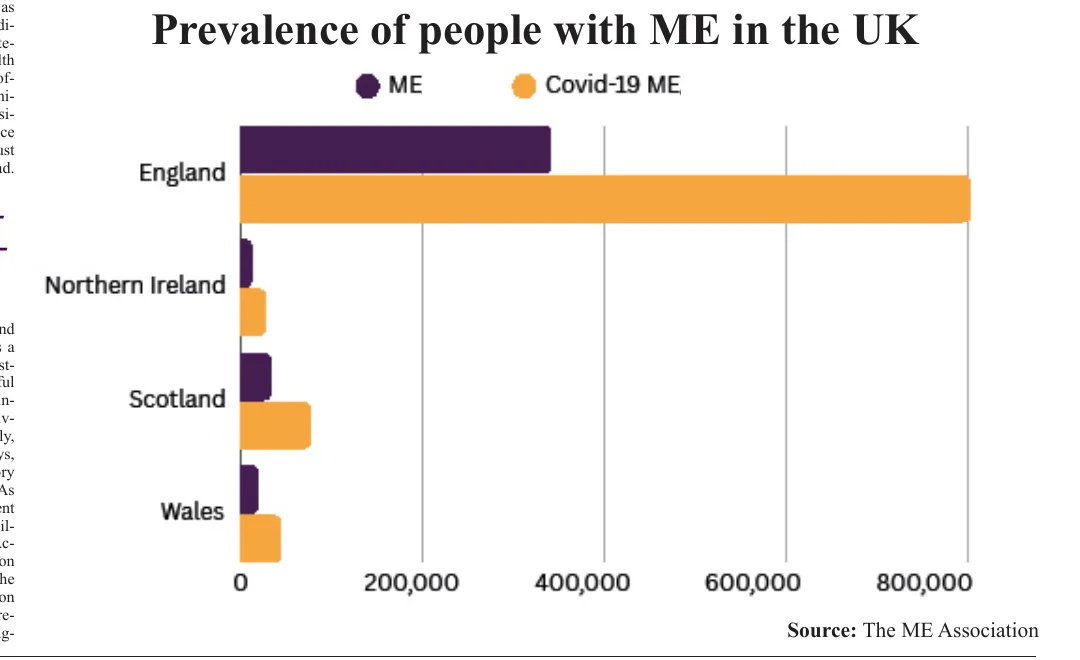
As it stands, there is no recognised drug or treatment for ME. In the UK alone, an estimated 1.35 Million people are affected by ME (data source: Action for ME) yet ME receives the tiniest fraction of the funding and public investment given to the conditions you might be more used to seeing on your tv or phone screens. Furthermore, while research efforts such as DecodeME are encouraging (and championed by Action for ME and the ME Association), research into ME remains decades behind most other disabilities and diseases.
All of this information is very important to share but it is not the sole reason I am writing this. I am writing this article because I have firsthand knowledge of how ME can mean unremitting pain and isolation, how ME makes you feel like you are losing yourself. I am informed enough to know that those with Severe ME are losing their lives.
The worst part? It is likely that most of you haven’t ever heard this until now. In October 2021, Maeve Boothby- O’Neill died after a decade-long battle with ME.
She was 27 years old. Restricted to a liquid food diet where she simply couldn’t consume enough calories to live, Maeve starved to death. Her mother knew it, her father knew it, she knew it, the GP knew it; yet nothing was done because, as Prof David Strain put it, there was not a “ward anywhere in the country at the moment that can provide the sort of care that is needed for ME patients.” Merryn Crofts died aged just 21 in 2018.
Sophia Mirza died aged 32 in 2005. It is sad enough that these women died so young. What is more upsetting is that deaths like these are wholly preventable but will continue to occur until societal and institutional attitudes improve.
People with ME aren’t just under attack from the condition itself, they are under attack from wilful ignorance. Carla Naoum, 23, was admitted to hospital in 2024, suffering symptoms stemming from her ME. Despite there being no ME specialist at the hospital to advise on such decisions, the psychiatrist assigned to oversee her care (although it is long established that ME is not a psychiatric condition) insisted upon removing accommodations for her condition, and told the family that she, the woman reduced to just 35kg, needed “to calm down.” That is the level of ignorance people with ME frequently encounter.
Not only does the condition itself require immense resolve to remain hopeful in, but people living with the condition find themselves having to fight and educate the people who should be helping them. Bear in mind, these examples are not the only ones. While ME news stories still struggle to get much mainstream media coverage, cases like these are not rare.
ME is a serious condition taking away livelihoods and lives, but it’s invisible
For the last few years, my mum has been living with ME. From 2021, mum became very ill, very rapidly. She was bedridden most days and she couldn’t eat much; she lost so much weight; she struggled for over 18 months to get above 40kg.
She couldn’t formulate her thoughts for large parts of each day, and she spent most days alone because she insisted I leave her and go to Sixth Form to get my education. But you know, the physical suffering wasn’t even the worst part of her situation. Unsurprisingly, my mum had to step away from her job as a primary school teacher.
It wasn’t a job actually; it was a vocation. Mum had worked in everything from hospitality, to sales, in management, in youth and community work, as well as in education roles, but she had wanted to be a primary school teacher since she was a little girl. When I was 8, we emigrated from Ireland to Birmingham, and Mum put herself through university (for the third time) gaining her PGCE qualification to teach full-time in the UK.
And my mum loved teaching. She’d arrive in early; she was always the last teacher out the door in the evening, and still, she would do more work at home after cooking dinner. She’d buy Christmas gifts and Easter eggs for the kids she knew might not get any; she had a soft spot for the pupils from less privileged or more challenging backgrounds.
She encouraged every one of her students to have the highest of aspirations. She cared so much about her classes that they, along with me, were “her kids.” To me, my mum was, and still is, my greatest inspiration, and she knows that. She also was, and still is, my greatest supporter.
Alongside the agony of giving up her vocation, my mum would, in the period where she wasn’t able to do much for me, cry with frustration because she believed she was somehow ‘letting me down’ as a mum. I didn’t see it that way at all. My mum did not choose to have ME.
Nobody would. And beyond that, in retrospect, she inspired me still, with how she coped. Living in a part of Staffordshire where we didn’t have family or friends nearby, having newly insecure finances, and insisting that her son go to Sixth Form every day and forget about home for a few hours, my mum would sit daily in the silence of her own pain, fatigue, nausea and brain fog.
In a letter detailing our experiences at the time, a 17-year-old me wrote that I just wanted Mum to “have her life back.” ME is a serious condition taking away livelihoods and lives, but it’s invisible so people ask, “Isn’t that the one where you’re just tired all the time?” or tell you that they “don’t believe in ME, sorry.” ME is misunderstood on a very large scale. Nothing I write here is going to change that overnight, and the hardest part of writing this hasn’t been trying to write it in pretty words – I don’t need to because the condition speaks for itself; the hardest part has been confronting myself with the details again. But if anyone who reads this learns something new and tells someone else, and that person tells another, then that’s a step towards the understanding that people suffering across the UK need.
Today, my mum is “doing better.” She still has ME in the Moderate to Severe classification; she has not been able to return to work and sadly had to accept permanently retiring from teaching decades before she would have ever imagined. Mum struggles still with day-to-day activities. Over time, however, we have learned what systems to put in place to help, and Mum has disability aids, and a small support network nearby now, who are indispensable.
Things are still challenging but life is brighter. Always a language and literature person, Mum has recently returned to writing poetry, and for her, finding the right words has also meant being able to picture a new path ahead to follow.