
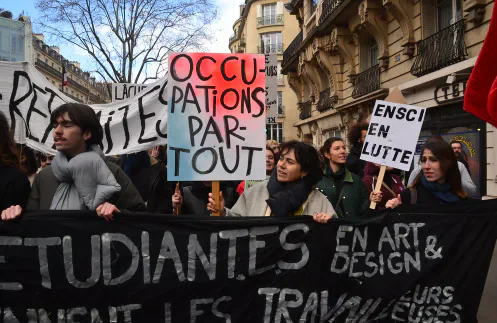
French President Emmanuel Macron’s decision to raise the pension age from 62 to 64 has been met with fierce opposition, triggering strikes and protests across the nation since the announcement in January. Macron’s defence for his controversial policy rides on the belief that the current system is unsustainable, given the changing demographic of the French workforce. In 2000 there were 2.1 workers for each retiree, which decreased to 1.7 in 2020, a figure which is expected to decrease further to 1.2 in 2070. Policy supporters also argue that French pensioners retire earlier than their European neighbours: the state retirement age in the UK is 66 and 67 in Germany and Italy.
The issue of pension reform is not new for France. Former president Jaques Chirac attempted pension reform in 1995 but this proved unsuccessful and faced mass strikes. His successor Nicholas Sarkozy, however, was successful in raising the retirement age from 60 to 62 in 2012, though not without huge backlash.
Macron himself also raised the issue of pension reform during his first presidential term in 2019. In a bid to keep the system financially viable, he proposed merging the 42 separate schemes for varying sectors; the response amounted to the largest protests and strikes France had seen since 1968. Due to the outbreak of the coronavirus pandemic in 2020, Macron’s proposals were never implemented.
Guardian commentator Angelique Chrisafis has labelled France’s pension system “the cornerstone of the country’s cherished model of social protection”, which differs greatly from the market-led system in the UK. Instead, those in retirement are funded by the working population who pay high payroll charges, a system which has been labelled “solidarity between the generations”.
Sky News have stated that, alongside the nation’s 35-hour working week and favourable unemployment benefits, their low retirement age “has become a staunchly defended “right” in the eyes of the public. This should explain the level of outrage.
Millions of French citizens have been protesting and engaging in strike action throughout 2023, but anger towards the proposals was further exacerbated by the government invoking Article 49.3 in March. Due to concerns that he would not receive the support of enough lawmakers, Macron used the special constitutional powers of the Article to bypass members of parliament and force the plans through. The article was invoked due to Macron’s precarious position in parliament, his En Marche party lost their absolute majority in the 2022 elections, indicating that there was no guarantee that the changes would go through. MPs triggered a vote of no confidence twice; the first was triggered by 278 MPs, but 287 are needed to succeed. The second by Marine Le Pen’s far-right National Rally, which was also unsuccessful.
At the time of writing, the most recent wave of protests occurred on the 1st May, France’s traditional Labour Day; marching trade unions turned their attention to the controversial pension reform. Though demonstrations were originally peaceful, violence eventually erupted on the edges of marches, resulting in 108 police officer injuries and 291 protestors being detained across France. In Paris, police fired teargas, while protestors threw petrol bombs and projectiles. Similar scenes were seen in Lyon and Nantes; cars were set alight, windows were smashed, and police again fired teargas. Interior minister Gérald Darmanin condemned the violence on Twitter, stating that though the “majority of demonstrators were of course peaceful”, police had been met with “extremely violent rioters”, whose objective was to “kill a police officer and steal property”.
Despite these disruptions, which reached equally violent levels throughout February, March, and April, Macron’s government has shown no sign of backing down. This is also in spite of polls indicating that two-thirds of the population support the protests. The moderate CFDT Union (French Democratic Confederation of Labour) have proposed mediation if the pension changes were “put to one side”, but these were rejected by government spokesperson Olivier Véran, who said of the pensions law: “It’s in the past now”. Though Macron’s government is aiming to move on from the pension crisis, outrage has continuously followed the president; recent visits to provincial France have been accompanied by boos and a sustained mood of anger. This indicates that the turmoil within France is highly likely to continue.