
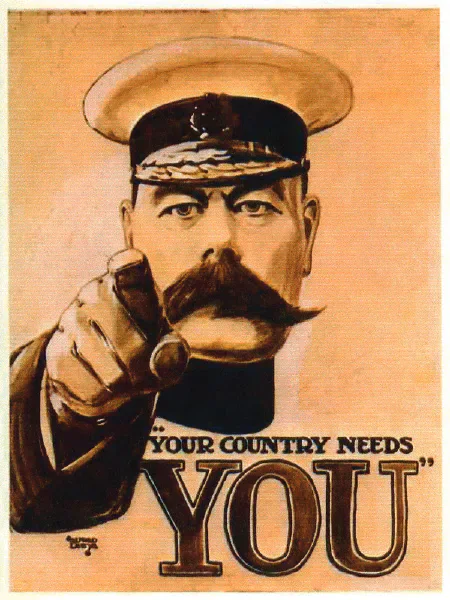
Iam generally not someone who worries about the legacy of the British Empire, it was such a large and varied phenomenon of the past that it cannot be surmised in binary terms. Nor do I really care to get involved with the cultural psychodrama about how we “confront” this past. One area, however, where I do get concerned and even annoyed is when we see the militaristic inheritance of our former power influence policy. Among those who rule us there seems to be a lingering conception of our country as a “great power” with the fortitude and capability to intervene for the good of the world. Such a view has come to the fore once more with talk of conscription and a possible land conflict, initiated by comments made by former army commander Sir Patrick Saunders. His speculation of a new major war was echoed by sabre-rattler Tobais Elwood MP who compared our current situation to that of 1939. Both men seem to think that military intervention is very possible in the future. Unfortunately, as with many politicians, they seem to be incapable of looking into the past and therefore considering the horrific reality of war.
It might be the ever-growing distance of our time to that of the Second World War, or our willingness to believe that every war is in some way a repeat of 1939–1945, that blocks some people from considering the human cost of conflict and its general futility. One needs only to look at photos from the past, of vicious wounds and shattered bodies or to look at cemeteries in France or more recent ones in Bosnia to realise the truth. War is not just another decision in favour of our interests but the utter devastation of a nation’s youth, something Ukraine is currently realising. We are blessed with a great nature defence, the sea, which effectively guarantees our sovereignty, or at least it did before the Navy was decimated by budget cuts. Thus, we have a greater degree of separation from any theoretical land conflict which might occur. Why then is there this eagerness to send men, and it will be mostly men, to fight and die?
As I said in a previous article on the Ukraine War, I am not a supporter of the Russian government, although some will still allege that I am. What I think however, in contrast to most of the media and establishment, is that we must learn to live with the Russians. Putin is not a “new Hitler” nor is he a fascist, instead he is simply just the latest iteration of Slavic despotism, surrounded by his boyars and keen to maintain his extraordinary privilege and wealth. Yet the idea that Putin is in fact a megalomaniac has some appeal for the NATO-minded establishment, who need an enemy for the sake of military spending. War of course appeals to leaders in trouble, Boris Johnson cynically abused the conflict in Ukraine to promote his own image as a great statesman, and it seems likely that our current weak Prime Minister may pull a similar trick.
But what would we the youth be fighting for? Ukraine? A country which is not particularly democratic, and as was pointed out by Peter Hitchens, is riddled with corruption and waste. And let us not forget that Zelensky has effectively muzzled the press, cancelled elections and even re-shaped the liturgical year to be more aligned to the west. If you ask me—and I suspect most other people—to fight for that, I would flatly refuse. Of course, people who are drawn to this kind of conflict will say that one must fight for one’s country, dulce et decorum est pro patria mori. But what country would I be fighting for? With its semi-feudal class structures and millionaire Prime Minister—no thanks. I would of course always defend the actual
landmass of Britain, but that is not what has been suggested. Instead, we must fight for our “interests''—whatever that means. Let us not forget this appeal to national defence has even failed in Ukraine, and I personally met many deserters in Poznań last summer.
Perhaps it would remove the last scraps of our national confidence, but I feel that we must move away from the inherited view of our country as a sort of global policeman, demoted since the war but still somehow important. Why do we need to get involved in so many wars across the world? With only the 6th largest economy and a GDP set to be overtaken by Poland in the next 10 years, could we maybe take a step back?
Maybe we might build some new schools, improve the railways or sort out the numerous problems which have arisen under Tory rule, before charging into battle. If there is to be war, how about a compromise whereby every Member of Parliament, civil servant, journalist, or “expert” who moves us towards a war with Russia, Iran, or North Korea, gives up themself or their children to fight. Not in the Officer Corps, but in the lower ranks. Let’s see how eager they are when they are deprived of the public to fight on their behalf.
It is probable that there won’t be a war with any of the assorted baddy nations of the world. But there is rising tension, which could lead to conflict and it is clear that some are willing to talk of it without considering how disastrous it would be. It is therefore essential for those of us who oppose it to speak up and counteract the warmongers in places of influence. Not as 'Stop the War' weirdos or Marxists but with the insight to understand the immense tragedy that war ultimately is.