
In a recent interview with the New Yorker, Nathan Felder spoke to journalist Eyal Press about the tensions which were encroaching on his synagogue congregation Beth El in South Orange, New Jersey. When Felder joined Beth El in 2020 the “We stand with Israel and We pray for peace” sign which stood in front of the synagogue had not yet been mounted. It was hung roughly a year after Hamas’s Attack on October 7th, 2023, to express solidarity with the 1,200 people who were murdered – in the largest massacre of Jews since the Holocaust – and with the 250 people who had been abducted by Hamas (Bring them Home Now! had been inscribed on the back).
Felder understood the Shuls’ decision to mount the sign. His own grandfather had been a proud supporter of Israel who in 1975, sold his home and moved to Beersheba, a city in Southern Israel. Felder himself had joined Habonim Dror a progressive Zionist youth movement and in 2001 after graduating high school had deferred college to spend a year in Israel on a kibbutz and then in Karmiel, a city in the North.
Last spring when Felder read the reports that famine was intensifying in Gaza due to the Israeli blockade of food and other humanitarian aid the “We stand with Israel” sign began to trouble him. Amongst other things he was concerned that neighbours would assume that he and his fellow worshippers condoned Israel’s actions. Felder viewed Israel’s blockade as a desecration of what his grandfather had taught him was a core Jewish tenet: protecting human life.
Outside of the synagogue’s entrance Felder unfurled a sign of his own; “Starvation is against Jewish values: our support of Israel cannot be unconditional”. Felder’s story is not unique. As Israeli actions become increasingly indefensible, a growing number of diaspora (Jews who live outside Israel) communities are horrified by Palestinian suffering that is perpetuated by Netanyahu and the Israeli government, leading to accusations of ‘disloyalty’ from one side and ‘blind nationalism’ from the other.
While the media has portrayed an image of heavy polarization between the staunchly Zionist and the fiercely anti-Zionist, in actual fact it remains far more complex. Roughly 7.2-7.5 million Jews reside in Israel constituting the largest share of Jewry worldwide. As such it is highly common for diaspora Jews to have family, friends and at the very least distant relatives who are Israeli.
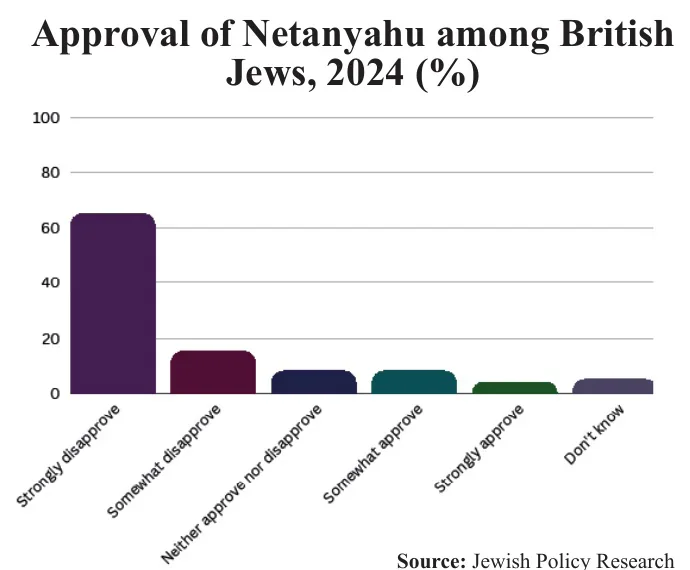
The reality is there isn’t one monolithic Zionist identity, nor are there two separate groups who are at odds with one another. Most Jews have a complicated and often painful relationship to Israel. In the summer of 2024 JPR (Jewish Policy Research) published a report corroborating these mixed feelings amongst Jewish communities in Britain.
76% of British Jews disapprove of Netanyahu
The data showed that 76% of British Jews disapprove of Netanyahu, with 74% believing that he prioritises his personal interests over what’s best for the state of Israel. Additionally, 54% believe that pro-Palestinian protests should be allowed to take place but 66% avoid them for fear of their safety as Jews, Overall, 72% of Jews have some degree of pride in Israel but 56% also feel some sense of shame, most feel a bit of both. Reading between the lines of the data, it feels obvious that much of the shared emotion is pain.
For many diaspora Jews the story is not one of certainty or division, but of living with a tension that refuses to be resolved.