
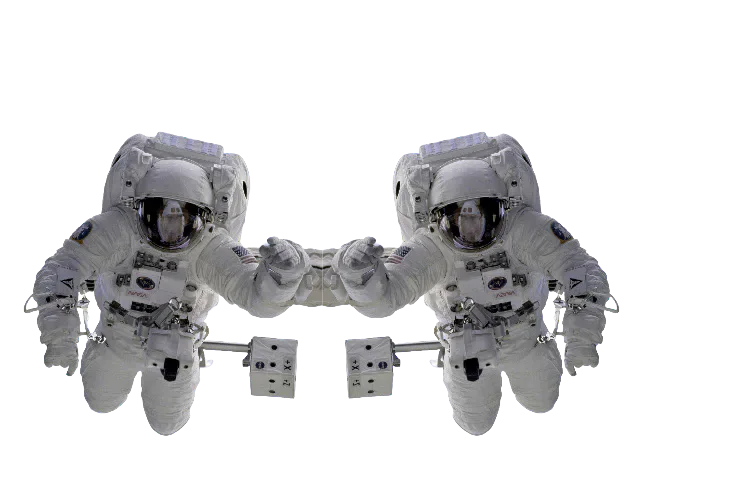
As we enter a world where space tourism is a genuine possibility in the next couple of decades, the question of the possibility of having sexual relations in zero gravity arises.
Sex in space is discouraged by NASA, and there is no documentation of it ever having happened, although we have to ask whether it is something that astronauts would admit to. There are only 279 astronauts who have been to the International Space Station since it was first commissioned, all of which have been highly trained, professional astronauts. That is not to say that they don’t have sex, but simply that when they are on the International Space Station, they are usually highly focused on the job at hand. They typically conduct experiments, fix the station’s structural elements or focus on keeping themselves and their fellow crewmates healthy and alive.
Since the International Space Station was first established, there has only been one married couple in space at the same time: Astronauts Mark Lee and Jan Davis, but they denied ever attempting any sexual activity while on board the ISS.
While no one has ever ever attempted to have sex in space (or so they claim), it doesn’t mean that it isn’t possible.
The main issue is gravity. How do you attempt to have sex when there is no gravitational pull keeping you in place? As Cassidy Ward says in her exploration of sex in space: “It’s hard to get down and dirty if there is no down.” An element of acrobatic skill may be required for couples to get any enjoyment out of sex as you are not able to stay in one place without tethers keeping you there.
Another element to consider is sexual fluids. As we all know, when men orgasm, they produce semen, a fluid containing sperm, which, when ejaculated into the vagina, swims towards the egg to try and fertilise it. In space, these fluids would likely just float, potentially creating a biohazard. Sex (if done correctly), is a physical activity, resulting in both parties involved being sweaty and exhausted by the end. Sweat, in zero gravity, would bead up and float to create what is essentially a sweat cloud, or sphere. I think we can all agree that floating semen and sweat clouds are not exactly the romantic atmosphere we want to create when enjoying sexual relations with a partner.
Scientists have also concluded that space pregnancies are not very desirable. Embryos, while in the uterus, require gravity to successfully form their bone structures and vital organs. So while there is a chance you could sustain a pregnancy in space, there is a significant chance that there would be medical deformities and long-term medical issues that the child would face.
As we look towards a world where the average person, rather than a highly trained astronaut, could be heading to space, these questions become more realistic. The real question is, who will be the first person to get down and dirty in zero gravity?