
In our last edition, Gair Rhydd interviewed Wendy Larner. After reading that interview, I, like many, questioned: Who is Cardiff University for? Its staff?
Students? Wales? The world?
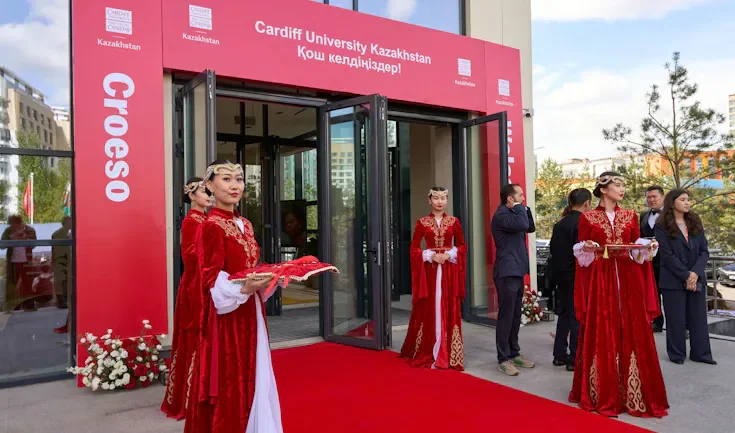
To answer a question like this, we need to look at the facts. Cardiff University has opened its first overseas campus in Kazakhstan. Who does this benefit?
Well, when asked by Gair Rhydd about the material benefits of the venture for Cardiff, Wendy Larner responded: “The New Futures curriculum, for example, has been piloted with the Kazakh students,” and the ability to “explore some of the wider opportunities for Cardiff and Wales that will arise through our relationship in Kazakhstan. Business-to-business opportunities, organisation-to-organisation opportunities.” Frankly, it is worrying that the first benefit given by Larner is the ability to trial a new curriculum; you do not open a new branch of a university in a country that has just passed an anti-gay propaganda law simply to trial a new curriculum. This could just as easily be trialled in Cardiff.
Unless the point of Cardif University Kazakhstan is to use Kazakh students as guinea pigs for the New Futures curriculum, it leads me to ask the question: Is Cardiff University taking the education and well-being of their Kazakh students seriously? Well, if the point of the venture is just to trial the new curriculum, and there continues to be little pushback on the anti-homosexual propaganda law passed recently, it’s hard to argue that they are. On the trade front, Kazakhstan’s main export is crude oil (53.8%); it is yet to be seen what benefits this could have for Cardiff, but what is clear is the downsides for the climate, with the New Futures curriculum claiming to address climate change.
Whilst Larner was flying out to Kazakhstan at great expense to the university, the financial situation in Cardiff was growing bleak. It was not long ago that 400 compulsory redudancies were proposed for university staff at Cardiff; whilst these are now no longer planned, they created a climate of fear and job insecurity for lecturers, which can only have harmed the education of students at Cardiff. This climate has not totally gone away, with voluntary redundancies still on the cards; lecturers at Cardiff do not feel safe in their jobs.
The future likely shows a shift away from Cardiff for Cardiff University
If no one takes voluntary redundancy, will mass lay-offs be back on the menu? The UCU shares this scepticism; the prospect of more job cuts still lingers and perhaps shows that Cardiff University’s priorities lie elsewhere, in other countries, getting questionable regimes to open trans-national branches of Cardiff University, rather than finding a way to save more jobs. The future likely shows a shift away from Cardiff for Cardiff University; the university is already planning for further ventures into the Philippines and Indonesia.
This will bring the material benefit of fancy flights and university funded trips abroad for the higher-ups at Cardiff University. On the other hand, the financial situation in Cardiff will remain bleak. It may only be a matter of time before the £30 million deficit is cited again to justify mass job losses, whilst university bosses are on all expenses-paid trips to Indonesia to promote trans-national branches in countries where promoting trans rights is a criminal offence.
Image: Cardiff University.