
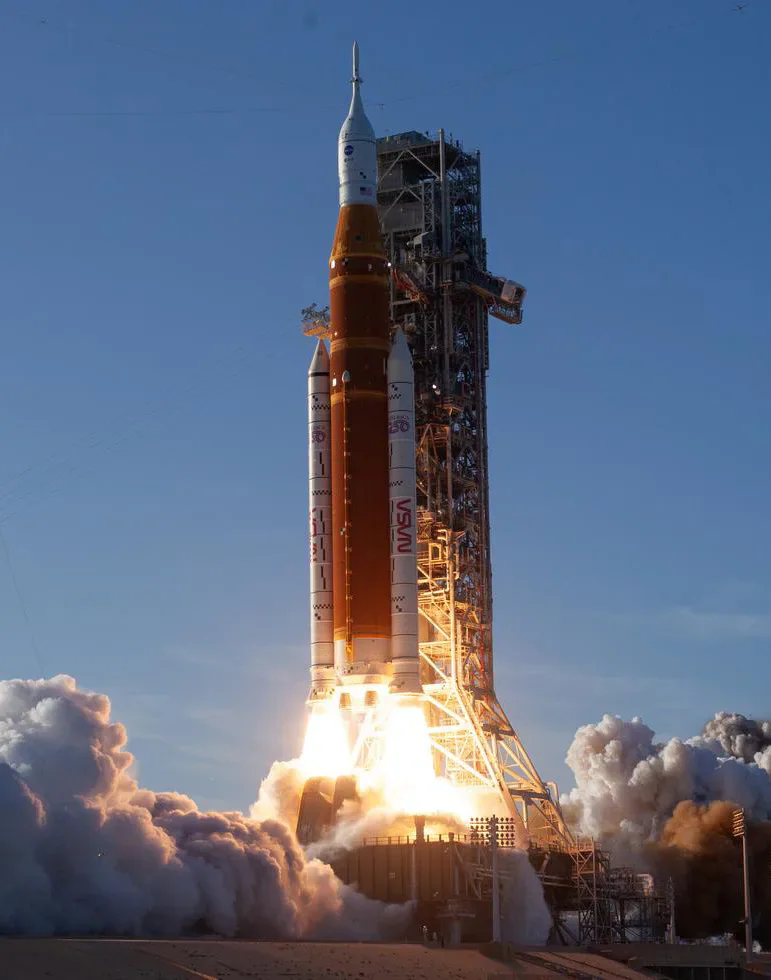
Over the Easter break, many of us plucked up the courage to turn our TVs on and flip over to the news channels – something we have all been avoiding for a quite a while. We gathered around our screens to watch as four astronauts took to the moon, a journey which has not been made since 1972. But whilst they marvelled at our oasis that we call Earth, the rest of us cannot be so easily distracted.
The Artemis trip was never intended to unite us. It is easy to envision humanity as this homogenous group when you only see a blue, glowing orb. But for most of us, it is hard to remember our similarities when armed combat and structural violence are all that seem to surround us.
The reality is the Artemis mission is only a piece in the puzzle of a continuing space race that is a direct result of conflict. Following the development of the atomic bomb, the US and the USSR fell into the Cold War, a competing battle for global power which lasted for the latter part of the 20th century. It was fuelled by ideological headlocks, technological advancement and war, with one of the main focuses being on space.
Space discovery has never been about progressing the entirety of humankind, but a route only to reassert a hierarchy amongst global powers. If you can colonise space, what is to stop you from total, complete hegemony? It is no coincidence that this mission has come at a time when the United States is involved in a monumental amount of conflict.
Space exploration has always coincided with military ambition - we saw this during the 1991 Gulf War, which marked the first large-scale military use of satellite technology. And today, this dependency is even more visible with Russia and Ukraine, and more recently with Iran and the US. When nations desire new surveillance, new weapons, and new strategies, they take to the stars.
Space is no longer a distant fantasy that is dreamed up in legends and films but is now a functional and contested territory used by powerful nations to compete for security and militarisation. Technological advancement is never a neutral achievement. We must remind ourselves - Who is funding this?
And for what cause? It costs NASA an incredible amount to hurl four people into space, which means contracts are going to be bought up by large, rich corporations. And to no one’s surprise, SpaceX and BlueOrigin, owned by both Musk and Bezos, are two of the largest companies that NASA rely on for this funding and technology.
Musk already sees space as his own cosmic playground, owning 2/3 of the 10,019 active satellites that currently orbit Earth, and simultaneously littering millions of pieces of debris into our atmosphere. What we are currently seeing is a concentration of power into the hands of a small group of techno-elites who seem to be getting a seat at the table for just about anything these days, with space exploration being no exception. SpaceX are receiving billions of dollars of US governments contracts – money which could have addressed the 37 million American people who are living below the poverty line or those struggling with housing costs or stagnant wages.
Instead, the money is being funnelled into the hands of individuals whose profits will not be shared with the likes of you and me. Space programmes are wrapped in nationalistic slogans, painted as though they are for the sake of our collective future and frame exploitation as exploration. Terence McKenna once said, “You do not depart for the stars under calm and orderly conditions”.
And whilst wars grind on and climate systems collapse, space becomes the ultimate distraction. It is easy to turn your eyes to the sky when there is wreckage at your feet. But under the surface remains the egotistical elite who fund their dreams at the cost of many and announce their achievements over the sound of bombs.