
A recent investigation by Gair Rhydd found 56% of students surveyed had experienced sexual violence during their time at Cardiff University. The majority (67%) reported they were subjected to sexual violence multiple times. Additionally, 70% of students surveyed had experienced sexual harassment during their time at Cardiff University.
While sexual misconduct is common at UK universities, with 25% of students experiencing harassment and 14% experiencing violence, the prevalence of incidents at Cardiff should not be ignored. Student organisation Time To Act states, “Sexual violence should not be part of the student experience. It isn’t a sad fact of life. It isn’t something that can be justified, accepted, nor tolerated.” But three years after Time To Act and Stronger Together challenged Cardiff University to improve their practice, sexual violence is still common and victims are still failed.
Data from survey respondents suggests Student Union (SU) events are high-risk for sexual misconduct. Most students (87%) who experienced sexual harassment said it had occurred at SU events, such as YOLO. Time To Act co-founder Bethia Tucker said SU events are “notorious for being filled with harassment and misogynistic behaviour”. One student reported a man trying to break down the toilet door while she and her friends were attending YOLO.
Harassment commonly took the form of leering or suggestive looks (76%), unwanted sexual advances or flirting (76%), or sexual comments or noises (72%). Unwanted physical contact (68%) and sexual jokes or innuendos (60%) were also frequently reported.
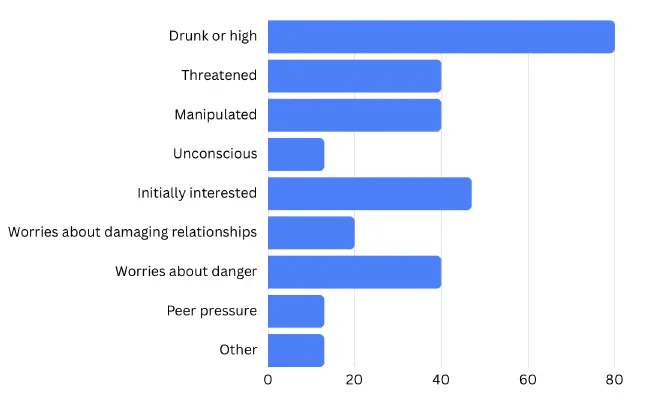
Furthermore, 80% students reported being drunk or high when they experienced sexual violence, confirming SU events (where people are likely to be intoxicated) may be a common location for misconduct. In comparison, national statistics show 39% of people are drunk when assaulted and the same percentage of perpetrators were drunk while committing assault. One student said, “He would get me drunk on purpose (even acknowledging the fact I was drunk) and I tried to say no but nothing would come out my mouth.”
Gair Rhydd found strangers were the most common perpetrators (83%) in sexual harassment and violence, in comparison to friends, friends of friends, or society members. These encounters make sense in the context of SU events, like YOLO, where large numbers of students mingle. It’s also supported by national statistics, which found strangers were more likely to be the perpetrator when alcohol or drugs were involved.
However, misconduct doesn’t take place exclusively at SU events, according to the students surveyed. Sexual harassment was also reported in SU buildings (26%) and society events (26%), although the numbers are much smaller.
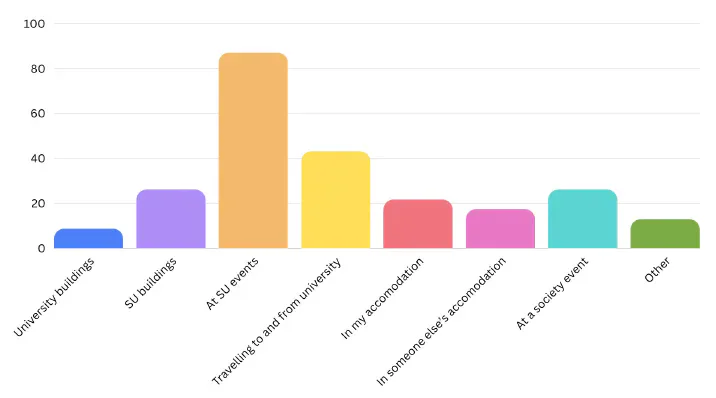
As many as 39% of students reported experiencing sexual misconduct in their own or someone else’s accommodation. This aligns with national statistics, which show sexual assault is most likely to happen in the victim’s or perpetrator’s home. One student said they “felt too unsafe to say no” to a partner “as it was at his house and on the 3rd floor with a house full of boys”. This is not an uncommon experience, as 40% of students reported they were worried about the potential danger if they said no to a sexual encounter. Given the alarming violence women are subjected to when rejecting men’s advances — which can result in severe injuries or even death in some cases — this fear isn’t surprising.
Most students (83%) said they had not reported sexual harassment or violence to the police or university. Not only does this suggest Cardiff University’s official data on sexual misconduct underrepresents the severity of the problem, it means perpetrators aren’t penalised for their behaviour. However, students commonly felt the system doesn’t punish sexual misconduct even when it is reported.
One student, who previously accessed the Report and Support system, said, “When I contacted the university about my rape, I was directed to some free counselling sessions... the focus was on me healing rather than consequences for the perpetrator.” This claim is supported by a Freedom of Information (FOI) inquest from 2023, filed by the BBC, which found 0.3% of reports made to Cardiff University resulted in an expulsion or suspension. From 2017 to 2021, one student was permanently excluded, despite 1454 cases of sexual abuse or violence being reported.
Gair Rhydd’s investigation found all students who experienced sexual harassment had experienced it more than once. Of those, 29% were sexually harassed more than ten times while attending Cardiff University. For students who had experienced sexual violence, 67% had experienced it more than once. It has to be questioned whether the university letting offenders remain at university plays a role in reccurring incidents — or if perpetrators knowing they will face no consequences for their actions encourages inappropriate (and criminal) behaviour.
Although Cardiff University’s policy states “anyone found to have behaved unacceptably may be subject to disciplinary action up to and including dismissal or exclusion”, the numbers suggest otherwise. Time To Act says the information uncovered by the FOI “shows a play-by-play of failure by Cardiff to acknowledge and act on sexual violence”.
Cardiff’s poor disciplinary record might explain why 58% of students felt the university did not adequately support students who experienced sexual harassment or assault. One student said they “haven’t heard hugely positive things” about the Report and Support system, while multiple said they didn’t know how the process worked or if it was helpful. Students were more likely to talk to a friend (92%), family member (35%), or a charity (23%) than go to Cardiff University’s report system (15%).
The Report and Support system was set-up in 2017, in the wake of the #MeToo movement, and received over 100 reports in the first six months. Students were promised the chance to meet with a staff member to “talk through the incident and its impact and discuss any practical help” within a few days. In 2018, Tammy Louise-Wilkins documented her positive experience accessing the new system for The Tab, writing “I’m glad I chose to use the support system, it opened up many support systems I didn’t know the uni had”.
Some students (23%) agreed Cardiff University provided adequate support for people who experienced sexual harassment and violence. Another stated the initial help was great, but lacked follow-up or long-term support. Like Louise-Wilkins, a student said they received “5 free sessions” with a counsellor — but, notably, the counsellor was not “sexual assault trained”.
If true, this suggests Cardiff is directing students to Student Wellbeing rather than the “trauma-informed practitioners” on their Student Support Intervention Team. Supporting students, particularly those who have experienced sexual violence, should be a priority of the university. But waiting times for Student Wellbeing are reported to be up to 18 weeks (four months), suggesting the service is oversubscribed and underfunded. It also isn’t a specialist trauma-informed service.
Long-term support is crucial when it comes to supporting victims of sexual violence as they experience higher rates of physical and mental health problems. Being subjected to sexual violence significantly impacts a person’s life and it’s unlikely five counselling sessions (especially if they aren’t trauma-informed) will provide adequate support.
It’s worth noting, in the recent past, Cardiff has been criticised for failing its students. In 2023, the university came under fire from the BBC for failing to support victims of sexual violence.
One student reported receiving no support and being hassled repeatedly by the university for fees she had already paid, the latter of which she didn’t receive an apology for. This goes against Cardiff’s policy, which states “victimisation of any individual making a complaint under this policy will not be tolerated.”
Another student said she didn’t report being sexually assaulted because she “heard from other people who’ve experienced similar things that they are not going to do anything about it”. Emily Carr, who previously served as Cardiff SU’s Women’s Officer, said complaints about sexual harassment and spiking were “flat out denied” by “senior members of the Student Union”.
Three years later, Cardiff students are not any more confident in the university’s ability to handle sexual misconduct. Of those surveyed by Gair Rhydd, 85% of students said they wouldn’t go to the Report and Support system. Among those, 15% said they would rather tell nobody at all.
85% of students said they wouldn’t go to the Report and Support system
Back in 2023, student organisations Time To Act and Stronger Together were formed to provide support for victims of sexual misconduct. Representatives from both groups met with university senior staff to discuss the mishandling of sexual violence, only to be let down again. Becca Rumsey, who co-founded Time To Act, said, “I raised the point about sexual misconduct, and how they need to do better to support their students. Unfortunately, three male academic staff were laughing - which highlights just how important what we are doing is.”
With the support of Cardiff students, the Time To Act motion was passed at the 2024 Annual General Meeting. This motion stated “Cardiff University and the Students’ Union [will] uphold their legal duty of care for victims of sexual violence at Cardiff University”.
The founders of the motion (Tucker, Carr, and Rumsey) said, “Many survivors of sexual violence who shared their stories with us, didn’t know they were able to get support from the university”. As Gair Rhydd uncovered, the majority of students didn’t know about or didn’t want to access Report and Support. Of those who did report their experiences, 44% were scared of facing repercussions, 24% felt they didn’t have enough evidence to ‘prove’ anything, and further 20% thought they wouldn’t be believed.
In addition to raising awareness of the Report and Support system, the motion wanted more education around consent and intersectional responses to sexual violence. Sharon Ng’ang’a and Ishani Patwal wrote in Gair Rhydd’s special ‘Time To Act’ report, “The fight against sexual violence and rape culture must be intersectional. We must move those on the margins to the centre”.
There were also concerns around society culture, in the wake of the Warwick rape chat scandal, which led to Time To Act’s recent ‘Don’t Be A Shitty Committee’ campaign. They provide free training services for Cardiff societies and sports teams, covering sexual health, sexual violence, and consent and active bystander training.
Since 2023, the SU has rolled out more educational material about sexual violence and harassment. For example, the SU building currently features posters on the definition of consent — it is a step in the right direction to run a preventive campaign against sexual misconduct, which targets potential perpetrators, rather than focusing solely on the after effects.
Consent is an important issue, as Gair Rhydd found nearly half of students who experienced sexual violence were initially interested in the sexual encounter but later changed their minds. However, 40% of students were threatened verbally or physically and 33.3% were guilted or manipulated into the sexual encounter. This suggests factors other than consent, such as the role of power imbalances and misogynistic violence, need to be tackled with equal vigour.
It is also important to recognise everyone who experiences sexual violence and harassment is different, with unique experiences and reactions. While one in four women have been assaulted, so have one in 18 men. One student said, “Worst incident was a guy in a club coming on to me, me saying ‘no, I’m not gay’, and him responding by putting his hand down my trousers into my underwear.” Unwanted touching was the most commonly reported form of sexual violence among students surveyed (87%), although 60% had been penetrated by a body part or object.
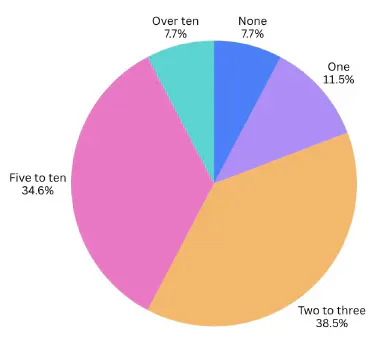
Sexual misconduct has become an accepted part of life, according to Time To Act, and is seen as an unavoidable part of attending university. Of those surveyed, 92% of students knew someone who had experienced sexual harassment or violence while attending Cardiff University. Among them, 39% knew two or three people and 35% knew between five and ten. This aligns with Report and Support’s recent report, which shows harassment is the most commonly reported problem at Cardiff.
However, Time To Act refute the idea sexual violence is a ‘normal’ part of attending university. They call for the university to make greater structural changes, hold perpetrators accountable, and tackle wider rape culture on campus. The recent investigation, conducted by Gair Rhydd, shows students are still likely to experience sexual harassment and violence, yet the majority don’t feel they’re being adequately supported. One student said, “I have found the lack of help (regarding both bringing the man to justice AND counselling) really difficult due to not living near home and not knowing people that well.”
If you have been affected by the topics covered in this form, you can talk to Rape Crisis Wales at 0808 500 2222 or start a free online on their website. It is anonymous and open 24/7.
Stronger Together is a Student Led Service offering community support to survivors of sexual assault/abuse. They hold 2 hour group sessions, every Thursday @ 3pm, Meeting Room 3E, in the SU.