
Over recent years, abortion rights in the US have become a central topic in political debate, with significant shifts in legislation, such as the overturning of Roe v. Wade in 2022. Questions arise about how Trump and his administration’s return to the White House might reshape accessibility to abortion. With initiatives like Project 2025 and prominent GOP members’ statements, a Trump presidency could bring drastic changes to women’s reproductive rights nationwide.
Project 2025, conceived by the right-wing think tank The Heritage Foundation, seeks to expand presidential authority and enforce an ultra-conservative social agenda, when the president-elect returns to office. The 900-page policy document sparks contentious disputes, as it highlights approaches focused on contracting federal support for abortion services, such as the proposal to eliminate the abortion pill mifepristone from market shelves, and to use the Comstock Act to criminalise sending abortion pills or contraception via the post.
This policy, however, affects not only women in the US but potentially women across the globe too. It seeks to stop American foreign aid from supporting the global abortion industry and desires to block funding to the United Nations Population Fund (UNFPA) which provides essential sexual and reproductive health services to women and girls worldwide.
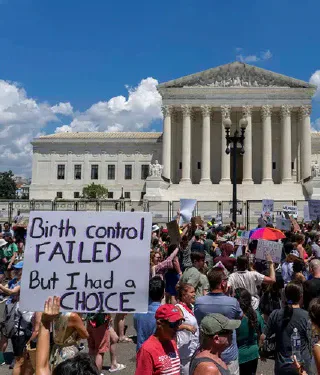
The push to restrict abortion rights in the U.S. ech oes the period following the overturning of Roe v. Wade. The Supreme Court’s decision to overturn the piece of legislation that guaranteed women the right to an abortion up until the point of foetal viability has already resulted in a seismic shift in reproductive rights, with states exercising newfound power to impose strict limitations on abortion.
For many women, this meant the closing of nearby clinics, the need to travel long distances for care, and even legal uncertainties when seeking medical help for pregnancy-related complications. The consequences of this decision are extreme, with some women reportedly facing criminal charges for terminating pregnancies in states with restrictive laws.
With that, one of the most concerning propostions associated with Trump’s presidency is the call for a national abortion ban. Republicans have raised the idea of restricting abortion across all fifty states, countering the assortment of current state laws.
Vice-President-Elect JD Vance has also voiced his opinions relating to abortion, stating on X: “There is something sociopathic about a political movement that tells young women (and men) that it is liberating to murder their own children.” This problematic move would essentially negate state-level protections and standardise abortion restrictions, leaving women in both Red and Blue states with extremely limited options. With the possibility of such a ban, the resurgence of strong resistance is not unexpected.
The force of resistance has already mobilised since the MAGA leader’s re-election, with American women drawing inspiration from their South Korean peers as they consider joining the 4B Movement. As a result of women’s frustrations regarding their reproductive rights, many have turned to the South Korean feminist movement as a powerful form of protest. The term 4B refers to four Korean words: bihon, bichulsan, biyeonae, and bisekseu, where the prefix “bi” means “no” in English. These words represent a rejection of heterosexual marriage, childbirth, dating, and heterosexual sexual relationships. Participants of the movement refuse to engage in romantic or sexual relations with men—aiming to challenge and dismantle the patriarchal system that sustains gender inequality.
With increasing support for a national abortion ban amongst Republicans, Trump’s oncoming presidency could mean that state protections become irrelevant, replaced by federal mandates that severely restrict reproductive autonomy. The future of abortion rights in America hinges on the broader ideological battle between conservative and progressive visions of reproductive freedom. As the debate intensifies, women’s rights advocates are calling on lawmakers to consider the long-term impact of these policies on individual freedoms, health, and social equity. Whether through political office or discourse on social media, the struggle for abortion rights will likely continue to define America’s social and political landscape for years to come.