
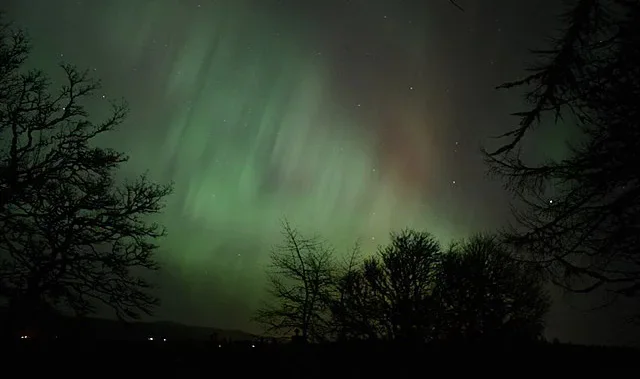
The Northern Lights have been visible all across the UK after the biggest geomagnetic storm since 2003—a G5, the highest on a 1–5 scale— treating many to a dazzling show of colourful auroras across the night sky.
These increased sightings have been aided by the Sun reaching a “maximum” in its 11-year solar cycle. During this solar maximum, our home star releases plasma, a scorching gas made up of charged particles that travel through space at speeds of around one million miles per hour in events known as Coronal Mass Ejections (CMEs).
The particles are captured by the Earth’s magnetic field, passing energy to atoms and molecules in the atmosphere, such as oxygen and nitrogen, where the gases then emit the energy in the form of light, resulting in the spectacular natural phenomenon.
In recent weeks, photographs have been captured across England, Scotland, Wales, and Ireland with the light display even being seen as far south as Kent and East Anglia.
According to Matt Robinson, an astronomer and astrophotographer from The Aurora Zone, “The stronger the storm, the further south in the Northern Hemisphere the Aurora Borealis is visible. This is why the Northern Lights have been spotted multiple times in the UK within the last 12 months.”
To those who have yet to spot the Northern Lights, there is still time. According to NASA’s Kelly Korreck, more displays are likely to be visible in the coming months and the Royal Astronomical Society states that sightings should continue into 2025, where the sun’s current peak is expected to last until the middle of the year.
Experts advise that the best way to view the phenomenon is to find a spot away from any light pollution or other bright light sources.
As the aurora is unlikely to look very vibrant or colourful to the naked eye, meteorologists have advised the best way to capture the event is by photographing the sky with long exposure or night mode—the longer the exposure time, the more light the camera can acquire and thus, the brighter the image will be.
However, many have reported that they were still able to see the aurora and its vibrant colours without using any form of camera.