
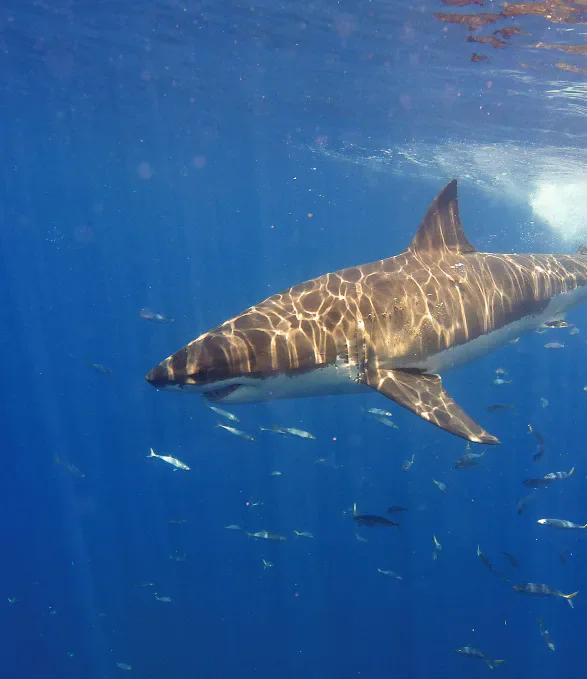
Adrone captured footage off the coast of California last year that could help scientists understand where great white sharks give birth and how they reproduce. The video shows a newborn great white shark, about 1.5 meters long, wrapped in a milky substance. This suggests that the sharks are born surrounded by a delicate layer of their mother’s milk, which is a unique reproductive process for sharks.
The video was published in the journal Environmental Biology of Fishes. A recent sighting of an undocumented reproductive behaviour in an enigmatic creature has been described as exhilarating by Phillip Sternes, a co-author and organismal biologist at the University of California, Riverside. The discovery has the potential to unlock key insights into the behaviour of these creatures, which have long remained a mystery.
This finding could pave the way for new discoveries and research in the future. In July 2023, wildlife filmmaker Carlos Gauna achieved extraordinary proximity to great white sharks off Carpinteria, California. Employing a drone to capture shark footage, Gauna encountered a peculiar sight—a relatively small and unusually chalky great white.
In contrast to the typical grey hue found on the backs of great whites, this shark displayed an abnormal appearance. Upon closer inspection, fragments of the baby shark’s usual grey skin were visible through a gooey white substance, creating the impression that it was sliding off the animal. Scientifically known as Carcharodon carcharias, the great white shark stands as a formidable extreme predator in coastal waters.
Bragging a strong, torpedo-shaped body, pointed snout, and large triangular teeth, these sharks, ranging from 15 to 21 feet in length, exhibit a diverse diet, including seals, sea lions, other sharks, and large fish. Their curious and sometimes aggressive behaviour, coupled with exceptional sensory abilities such as a keen sense of smell and the use of the ampullae of Lorenzini, adds to their mystique. Despite not being endangered, great white sharks still face threats, emphasizing the importance of conservation for their crucial role in marine ecosystems.