
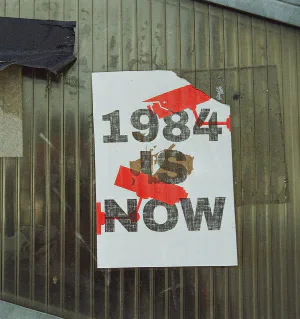
Has anyone else noticed we’re living in a dystopia? I’m not talking about the increasing trend of people falling in love with AI chatbots, although it’s easy to draw a parallel to the 2013 film Her. Talking about artificial intelligence in science fiction movies is surface level and reductive — I’m pretty sure AI creators want us to feel like we’re in an episode of Black Mirror (2011-).
The reason I feel like 2026 is a dystopian society goes deeper than technological advancements.
This realisation first hit me when Google Pixel was advertising the new Magic Eraser tool. With one easy tap, you can remove entire people from your photos. It promises to remove ‘distractions’ from the background (though the commercials try to appeal to your emotions by suggesting you erase your exes). Although this seems harmless, altering or destroying photos is a way of erasing or rewriting history. In the classic 1984 (1949), Winston Smith is overcome when he discovers a photograph of men gathering at a time and place the regime claims to be impossible.
Winston’s job involves rewriting old newspapers for the Party to support propaganda, something we now do regularly. Editing a typo you made in a post is one thing but in the digital world, it’s easy to completely change the statement you originally made. Despite worries about online footprints, information is slippery on social media.
Not to mention, false information is circulated so widely it becomes accepted as fact. Yes, this has been worsened by AI hallucinations, but it was already happening with ‘fake news’, psyops, and bots.
Speaking of 1984, we’ve got our own version of newspeak: Orwell’s fictionalised language which minimises vocabulary, removes nuance, and limits the freedom of expression.
Obviously, slang and shorthand are a normal part of human culture. However, it has become normal to use algospeak (coined in 2021) words like ‘unalive’, ‘pdf’, or ‘pew pew’ as a form of self-censorship.
Originally, these terms were supposedly adopted to avoid posts being deleted or hidden by social media algorithms. But their normalisation detracts from the severity of the subject matter, such as using ‘unalive’ to talk about a murder victim, and psychologically distances the user from it. Suddenly, we’re all one step closer to citizens of the Capitol talking nonchalantly about children dying for our entertainment because it seems unreal to us.
We’re all one step closer to citizens of the Capitol talking nonchalantly about children dying for our entertainment
The Hunger Games (2008) is a dystopia which is commonly compared to the modern world. While capitalism and consumerism are valued highly, with everyone buying the latest foods and fashions, the number of people living in poverty continues to grow. It’s no secret Mr Beast, the biggest YouTuber in the world, rolls in millions from exploiting poverty porn and making people literally fight for money.
Recently, I can’t help but compare the Hunger Games to the Olympics. Athletes don’t fight to the death. However, we see the same desperation, people trying to appeal to the audience, risking their lives for entertainment, and extreme political propaganda. I don’t intend to diminish the lives lost in the Ukraine genocide by saying this, but Vladyslav Heraskevych being banned for commemorating the dead is something we see in The Hunger Games repeatedly.
In The Hunger Games: The Ballad of Songbirds & Snakes (2023), we see Reaper cover the dead bodies of the Tributes with the Panem flag. They are victims of the ongoing genocide. Immediately, the camera cuts away.
Viewers know this is the corrupt state trying to clamp down on a rebellion. So, why do we let the International Olympics Committee commit the same act of suppression?
I could go on. I could remind you of Fahrenheit 451 (1953), where books were reduced to summaries (sound familiar?), then eradicated and replaced with 24/7 live television streams. The squip implanted in people’s brains in Be More Chill (2004) is eerily similar to an AI assistant. Meanwhile, the isolated existence of people living entirely online in Ready Player One (2011) is akin to our loneliness epidemic.
It’s easy to point to these examples and hundreds of others as proof we live in a dystopia, but I think I’ve made my point.