

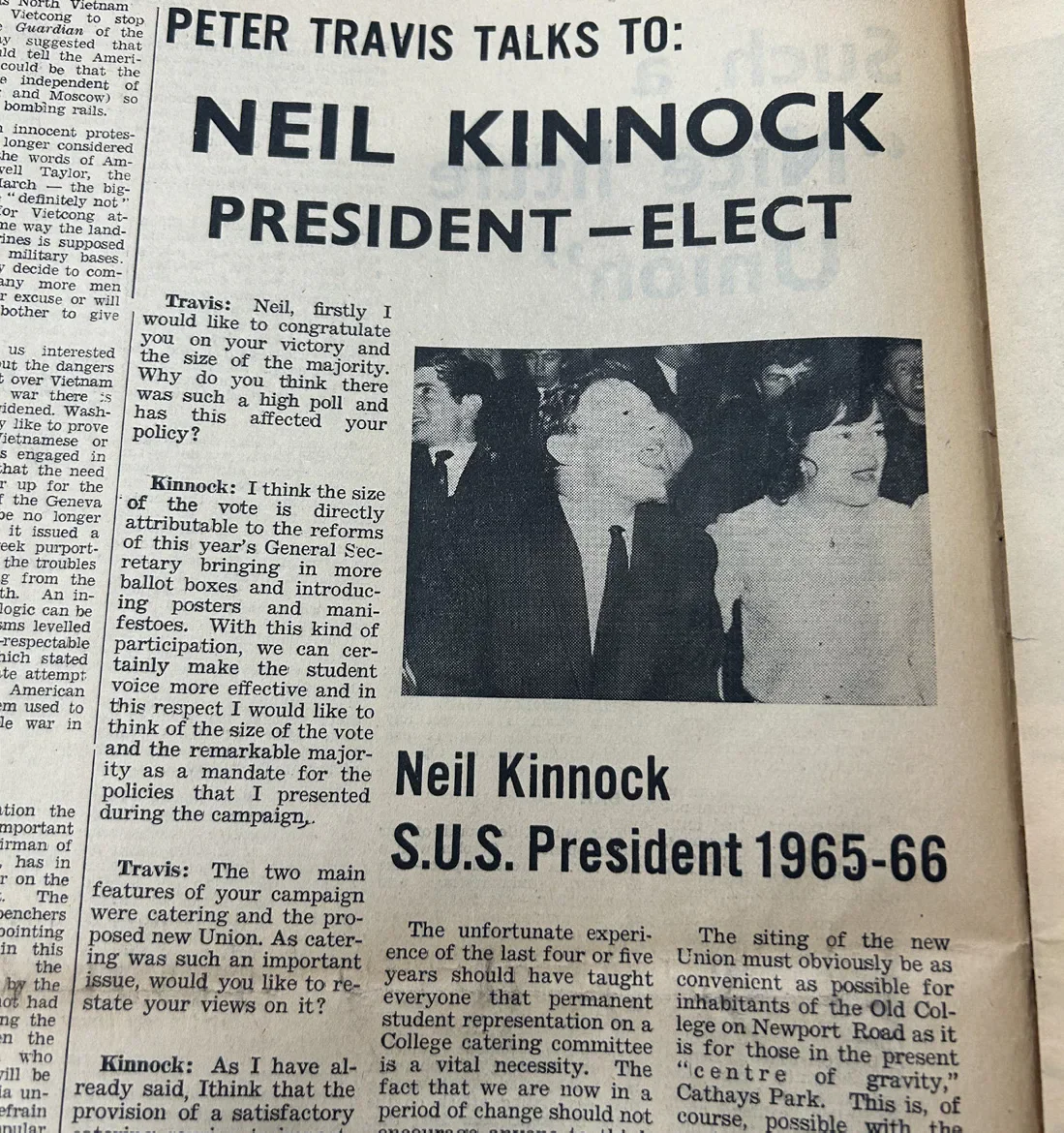
Lord Kinnock, thank you for having us. Your political career began in Cardiff, where you were the SU president. Could you begin maybe by describing your time in that role?
I've been a member of the Labour Party since I was 14. I was allowed to join three months before the official date by a very friendly county counsellor in Tredegar, which is where I was born and brought up. And then I went to Cardiff and joined the Socialist Society.
As these things happen, I was elected Secretary after being in university for about three or four months. Then the following year I talked a young woman from Anglesey into becoming secretary in her third week in university. I married her five years later.
I then became President of the Socialist Society, and we were extremely active politically, not just in student politics, indeed, not even mainly in student politics. In 64, there was the general election in which labour won after 13 years of Tory rule, and then 66, when Labour won a big majority. In between times, of course, there was the Cuban Missile Crisis, there were the Rivonia trials of Nelson Mandela and his colleagues, and the '60s, the late '60s, were a swirl of political activity in which we were heavily engaged.
So that was not a baptism of fire, but fire wasn't absent. Do you feel that the role prepared you for your political career? Not really.
I would have been active and engaged in politics in any case as an activist. What did assist, I guess, is that when I went to university, the first year, I played rugby and I sang a lot and I was out with the lads a lot. Then Glenys arrived.
I met her, poor girl, on her first day in university and I started to take her home, but I had a kick in the head and I was suffering from a delayed concussion. So, I passed out and she ended up taking me home from our first date. In order to impress her the following Friday, I spoke in the Union Debate for the first time. “The debates union in the There was a complete absence of deference and good manners.
So it was hellish. But I managed to get through that, and I managed to impress her, which was the intention. Then I found myself stuck with being, not only actively engaged in the Socialist Society, but in the politics of the Union.
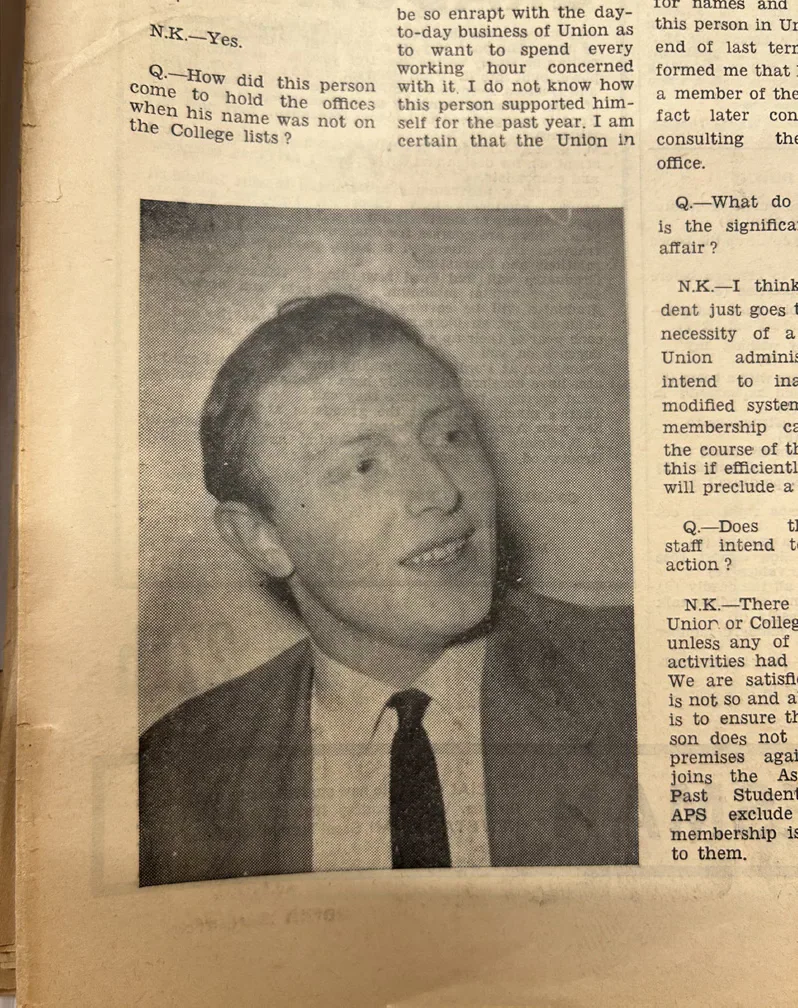
So, in a sense, it was a sort of involuntary training, because I learned to take the punches as well as giving them, learned to be indifferent to insult and to enjoy a little bit of praise. I suppose that's a fair old grounding in active politics. And as you mentioned, you were SU president during the upheaval of the '60s, and known to support anti-apartheid efforts.
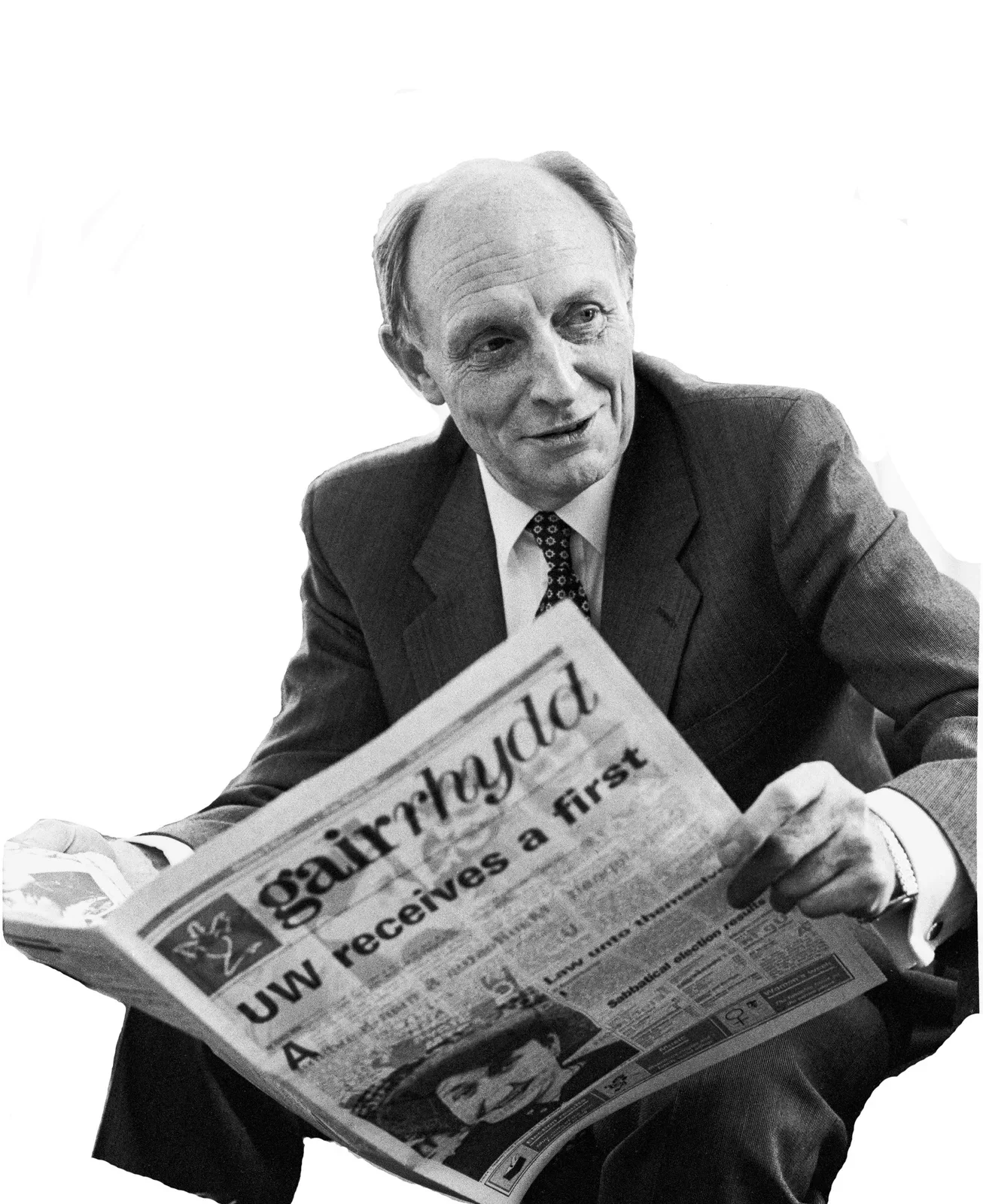
What do you think of the efforts by Cardiff University to prevent protests by legal injunctions? I think that if it involves invasions of premises, the University is within its rights to try to prevent the possibility of damage and of disruption that could affect students who are not directly engaged. Otherwise, I think that efforts to prevent protest as a general practice are fruitless in any case.
And on that topic, do you feel that student politicians have the same voice and agencies that they might have done in your day? We had no voice or agency. We made a hell of a lot of noise, and nobody took any notice, as you would expect.
I can say from the great height of being 83 years of age, there are times when much more notice should be taken of youthful opinions and concerns. The fact that they are held by young people doesn't invalidate them in any way whatsoever. In fact, in some cases, it makes those concerns more profound, and it makes some of the answers more useful.
But in the nature of human society, very little premium is attached to ‘youthful wisdom’. In fact, that's thought to be a confusion in terms. So, I would have liked more interest to be taken and action to be taken on the basis of my generation's recommendations, but it was never going to happen.
I don't think people ought to be disappointed or frustrated when they're not heeded today. That’s in itself a kind of lesson and the spur to further motivation. People shouldn't worry too much about that.
The thing is, if what people are doing is born of serious purpose, progressive, and enlightened purpose, and their convictions run deep, they'll hold on to them and be able to apply them in practical conditions. If the convictions are shallow and they're afraid of compromise and not aware that most progress is gradual and cumulative, then the convictions that they've got are not really worth having in the first place. “There's just one lesson I draw and it is that the way to avoid disillusionment is to try to avoid illusions in the first place. And if people can do that while sustaining serious enlightened purpose, that's a good combination.
So, you would say a lot of what was happening in those days was an illusion? No, no, no, the concerns that people had arose from serious purpose. The terror that people felt over the Cuba crisis for instance, the bitterness that they felt partly because of acquaintance with students from the Middle East, over conditions in occupied Palestine, the West Bank, the treatment of Kurds and concerns that people had about living conditions in the United Kingdom, rack-rent landlords, abuse of landlord's rights, low pay, all those concerns that are still tragically current.
They're worth bothering about. So, they weren't illusory in any way at all. Anybody who thought that there was some sudden and dramatic immediate way of resolving the concerns would have been suffering from illusions.
But I don't think there were many people who thought change could happen with dramatic suddenness. The test always is, can you endure when you appear to be making little headway? The tribute I'd pay to some of my colleagues is that they went on, in very many cases, to gain distinction in their fields of study and in their professions and still endured in their convictions.
I think that's highly commendable. They didn’t become disillusioned because they didn’t start with illusions. We’re marking 40 years since your speech in 1985, where you tested the two themes of conviction and endurance.
Do you think the current party leadership have gone too far in abandoning the ideological elements of the labour movement in favour of electoral success? Well, I’m not keen on ideology because it too easily turns into dogmatism and that, to me, is poisonous. It means fixed ideas that don’t pay sufficient attention to inevitable and continual changes in circumstances.
I have always tried to avoid or discourage ideological stances, doctrinaire stances. However, having a sense of conviction or having principles that can be effective in practice, which is the only real test I think necessary. Politics that lacks conviction, lacks direction.
There’s no compass, there’s no chart. And it can mean that politicians who are without that equipment can be driven by the winds. And the winds change.
So, I think it’s stupid to have fixations, ideologically, but I think you’re impoverished if you don’t have basic values that are applicable in practical conditions. Do you think the winds are pushing around the current Prime Minister? I know that he’s a man of very deeply rooted principles, and highly intelligent and in many, many ways admirable, not only because of what he’s accomplished in his life, but because of what he wants to do for the country and the rising generations.
He’s inherited appalling conditions. And I think what’ll get him through is the values that he holds to. I just wish they were expressed with greater determination and clarity, so that the Labour Party generally and the country generally had a clearer indication of purpose and direction. “I’m certain that Kier knows what he’s doing and why he’s doing it.
And on that general topic of the emphasis of finding solutions and real world progress, you’ve spoken out about that topic and said that for the government to kind of slow down the growth of parties like reforms, for example, that there needs to be.... No, they’ve got to combat. Not slow down, combat and overcome.
To combat parties, like Reform. Given the current economic climate and the emphasis on that, what would you say to the people who say that the government ought to be a lot more radical in their policy decisions? Well, radicalism without means is just a word - it doesn’t mean a hell of a lot.
So, the important thing is to ensure that you’ve got the resources, the revenues, that enable you to fund effective change that can alter people’s lives to their advantage. The major challenge that the government faces at the moment, of course, is obtaining those revenues. Now, the challenge comes at two levels.
One is the obvious direct challenge of achievement, of restoring so many of the vital public services, including the NHS and much of education. That is absolutely vital. But the other challenge is a political one, and it arises because we’ve endured over a decade of conservative government, which effectively stripped the services bare and guaranteed underperformance in the wider economy by underfunding public investment in both the physical and the intellectual infrastructure.
So the economy is weakened in any case, and it means that the communities that were devastated by the years of Thatcherism and what followed from it over the subsequent period, rightly, feel that they’ve been neglected, ‘left behind’. Their resentment takes the form of votes for populist nationalist parties and it does mean that the current government has to face a challenge arising out of conditions that are not in any way their fault. “They’ve got to try and repair the devastation that is cumulative and has a terrible effect over the best part of 30 years, whilst dealing with fresh challenges deriving from everything from Brexit, to They’ve got to fight today’s battles while helping as much as they can to overcome the consequences of what occurred in this country in the 1980s and early 90s. Now, I’m not trying to avoid responsibility on their behalf.
But I think when that dimension of inherited devastation is comprehended people can understand the current challenge both in direct policy terms and also in political terms. They can then see why populist nationalism has surged and is having an appeal. If they think about it hard enough, they begin to comprehend how it can effectively be combatted and the tide turned so that rational, responsible, accountable democratic politics can be reasserted in our country.
That’s a main challenge for the government. Do you think that reform poses a threat to democratic politics? Yes.
Simply because it relies so heavily on sowing and harvesting grievance, resentment, division. I know why its messages have achieved appeal. I also know that they’re entirely superficial and exploitative.
And I think given long enough, people realise what a bunch of snake oil salesmen and con men they really are. But we haven’t got the time to allow for consciousness to improve. I think we’ve got to assist it by pointing out what they’ve stood for, what they stand for, what their so-called policies are, and how superficial and synthetic they are, how impractical and divisive they would be if they were ever put into practice. “So I think that one of our duties is the nonest exposure of Farage and Reform for the charlatans that they really are.
Staying on the general topic, when you led labour, Britain was very strongly of a two party system in the 92 election labour and the conservatives. It was starting to change. Today, especially with the current challenges to the popularity of Labour and the Conservatives, we're seeing a much more split-up electorate who are backing very diverse parties.
Might it be the time with that mind to start strongly considering options of reforming the electoral system? Yes, certainly. I'm in favour of a more proportionate system and there are some systems that could really benefit the United Kingdom, especially proportionate systems that would sustain the constituency system, which I think is crucially important.
I don't want multimember constituencies. One constituency, one representative I think benefits clarity and transparency, as well as the quality of public service. So, I'm very much in favour of a more proportionate system - I have been, especially since 1983, when Margaret Thatcher got a thousand percent of the power on 42.7% of the vote.
The division in the anti-conservative majority provided massive benefit to the Conservative Party for most of the last century. So I'm in favour of securing change. The real difficulty we've got now is, first of all, there are people in all parties who still continue to believe that the current first-past-the-post system provides stability and continuity.
I think that you only have to open your eyes to see the absolute falsehood of that. It did exist, as you suggest, when British political opinion was broadly divided into two and a bit parties. There was a rough proportionality about election results.
That rough proportionality has turned into disproportionality now, which is why it's got to be rectified. We now have a country with a first-past-thepost system and a tactically voting electorate, which means we've got a proportional representation electorate and a first-past-the-post system. That difference has got to be rectified.
So where would you say Britain is as a country at the minute, with national positions on various issues like we've spoken about, perhaps having shifted in recent years, what do you think the political identity of Britain looks like today? I think it's confused. I really do think the country is confused.
Some of the confusion is attributable to the means of communication we've got, notably a press-which is still significant that is almost entirely owned by billionaire tax exiles, who then give us lectures on patriotism. I find that very interesting [he said with some irony through gritted teeth]. Anyway, the confusion, if we were want to be very grand about it, is to do with a system which has taught generations that this was a great imperial power, that fought two world wars, had its moments of heroism, (which is the true bit, because of the endurance and courage of the population generally) and then fell into lassitude and laziness and ineffectuality.
That, of course, is entirely manufactured. But there are now people who are earning reputations and gaining political support by offering this extremely inaccurate and very misleading nostalgia in place of accurate history. They also make a living and gain support out of bemoaning the condition of the country, giving the impression that it's ‘broken’, that it's damaged beyond repair, and the only way in which past glories can be restored and ‘Britian made great again’ is if we stop immigration.
You know the narrative. I don't have to tell you anything about that. Of course, most of it is complete rubbish, particularly the part about immigration.
In an ageing society, with demography demanding intelligent responses, we need the nourishment of a lot of young people who come here to work to earn and to pay their way in order to sustain the decent standard of living for an increasingly large older generation, which includes me. I think that people would have a more accurate perspective of where we are as a country if they were given a clearer and more accurate view of what the past 80 years have really been about. They would also appreciate that for 30 years after the war, the United Kingdom, in common with much of the rest of the world, prospered because of intelligent economic policies in several countries that understood that the role of government was to sustain stable and advancing rates of economic growth, which generated pretty widespread prosperity and justice and enabled the development of the welfare state.
And it was only when that was brought to a crashing halt by serious economic crises in the 1970s followed by the years of Thatcherism that we really started, as a country, to lose confidence in ourselves, to believe the worst about ourselves, to have such doubts about our capacities, that the soul of the country to some extent, has been endangered. But the soul of the UK is not gone. There are still great instances of inventiveness, community spirit, audacity, constructiveness, originality, creativity, all wonderful characteristics, but they so rarely appear on the front pages of newspapers and other means of communication, so this confused characteristic of the country at the moment is generated and sustained.
I very much regret that, as George Orwell said, "If you want to control the future, control the past”. And to some degree, there are malign forces at work that are making quite a practice of inventing the past and controlling a distorted version of it.. And do you think, on the soul of Britain, that perhaps the aspect of multiculturalism is particularly unstable at the moment with that challenge of people who are trying to put the message forward?
Yes, the unfortunate thing about multiculturism is that it's been allowed to become a label when it's a reality. The world in which we live is, by definition multicultural and we are part of that world - partly because the United Kingdom did have an empire and the empire is coming back home. We are bound to be multicultural.
The revolutions in transport and technology guarantee, in any case, that society is more mixed and diverse than it was even 20 years ago, let alone 50 or 80 years ago. Ithink that because multiculturalism is asserted as a curse from some quarters and as an unqualified blessing in other quarters, that we've actually got something called the Culture War. All wars are pretty stupid, but this one is probably the stupidest of all.
I mean, multiculturalism is a reality. Deal with it. Certainly, enjoy it.
Take advantage of it. The moment that it's regarded with suspicion or as a malevolent force, I think we're trying to step off a moving world. That’s simply not realistic.
You've been in this building around Westminster for a very long time. 55 years. Do you think in the last two years you've seen a real shift in the political atmosphere here with those what you describe as maligned forces taking more of a share of the attention. We have five reform MPs, if that's what you mean.
You said that they do a lot of press conferences, do you think that the commons itself has been sidelined as a space for debate? Do you think that a lot more politics takes place outside the chamber than it would have done in the past? To some extent, that's inevitable.
The existence of 24/7 rolling news and new technology means that Parliament is going to have to work very, very hard to maintain its status and function as the crucible of national opinion. So, to a degree, what you describe as ‘sidelining’ is inevitable. It's still the place where the law is made and it's still the place where major political collisions will continue to take place.
But in its day-today business, it really, in many ways, can't hope to rival the instantaneous nature of news creation and broadcasting. And it shouldn't try to do so. The principle that government statements should be made first to the commons and not to press conferences, is a principle really worth sustaining in the name of accountable democracy.
But other than insisting on that principle, enforced by the speaker, and respected by members of Parliament, it's very difficult to see how the commons can match the generality of coverage, which is now available by other means. You talk about the movement of debate outside of the Commons and, of course, in Wales, we have the Senate which is over 20 years old. We discussed the confusion in the country and its lack of direction in some ways.
But do you think that and, I know that you were hesitant about devolution.... No I wasn’t hesitant, no, it's a good point for you to raise. I've never been hesitant about devolution.
I'm entirely in favour of decentralisation and I have been since I was in my teens, especially in a country, which has increasingly been disadvantaged by being overcentralized. So I'm in favour of devolution as a purpose and a principle and a practice. What I opposed - I wasn't hesitant - what I diercitly opposed in the late 70s was the form of devolution that was on offer and which we've ended up with.
My argument was then, and is now, that if devolution is a good idea, which it is, decentralisation is a good idea, which it is, essentially, then it's good for everybody. The great fault of the 1978-79, and the flaw in what we've got is the fact that we've got it in Scotland, we've got it in Wales, but in England, we've now got a patchwork quilt of mayoralties, counties, unitary authorities, and it just goes on forever in utter confusion. Now, if only the people directly involved, the councillors and the members of the Scottish and Welsh parliaments were affected, well, who gives a damn?
But actually, the people - the public - are affected. They're not getting the quality of governance that they should, becuase there is a completely incoherent system of financial allocation. Wales is under funded by about 3 billion pounds on a 25 billion budget, so it's a hell of a lot of money.
It's underfunded partly because of the formula being employed. “Joel Barnett was a friend of mine. He started arguing against his own formula within about a year of him inventing it literally overnight 47 years ago. We've still got it and it should be changed.
It's the fact that decision making about the use of resources and the collection of revenues is really centralised. It just means that, instead of enhancing confidence in democracy because of proximity of decision making and accuracy of political perceptions, the devolution we’ve got is having the opposite effect. People are switching off because they can't see an advantage.
They can't see progress being secured by what I call the sliced loaf form of devolution we've got. I think that, despite the very best efforts of great people like Eluned Morgan, and she's a wonderful woman, it's got to be rethought. We've got to have universal decentralisation, not pick and mix decentralisation.
What I call sore thumb decentralization, which is the form of devolution we've got, against the background of the patchwork quilt. Do you think that the separate institutions are sort of creating a drifting effect within the country? You see in Scotland, do you think that actually that's damaging the country or do you think it might be an advantage?
Well, it doesn't help. And it's inevitable, the kind of divisions we've got. What you've got in Whitehall, in Westminster, a government of one party, and in Edinburgh or Cardiff, a government of a different party, you've got an automatic tension built in.
You've also provided the party in Edinburgh, the party in Cardiff with an automatic alibi for anything that goes wrong because it's either because this centre has allocated the power, but not the money the real power to operate. And so you've got devolved institutions that are eunuchs. They've got all the responsibility and inadequate resources to exercise their power.
Now, that is a very confused and unsatisfactory set of conditions. Then you get the same party in power in Whitehall and Westminster and in the devolved administrations. So, the devolved administrations carry responsibility for the central government, as well as for themselves.
But you haven't changed the funding formula, and you haven't altered the status of this devolution. The consequence is that the same party is in two different places, and is going to be pulverised from both ends. You can see it happening.
I take no pleasure at all in saying ‘I told you so’. But I did warn about all this in 1978 and it wasn't rocket science. It's organically part of politics.
It's so easy to analyse and to see, but people who wanted it claimed it would ‘polish off’ nationalism. That's really worked, hasn't it? Especially in Scotland.
It didn’t polish off nationalism, it gave nationalism its great opportunity, which they've seized. They've been able to rule for, what, the last 18 years, having a degree of power and great significance in Scotland without bearing full responsibility. So it's quite nice for them, and it doesn't work for the people, which is the real test.
Do you think Britain might have lost its international influence in the last few years? Yeah, scrapped it with Brexit. Because, there are people, lots of people actually, who understand that the engagement in the European Union wasn't simply an economic integration.
It was a very, very important political alliance between a large number of sovereign democracies, unique in the world. What some people realise too, though it should have been pointed out, more effectively than it ever was, is that Britain exercised disproportionate influence in that. I celebrate that, not for nationalistic reasons, but because, generally speaking, that influence was progressive and benign. “The problem is that for much of the time that we were in the European Union, we had governments by a Conservative Party that after initial strong enthusiasm started to treat the European community, the It was all about who won and who lost and what did we gain and how did we do down the others, and how they were trying to pillage our influence, our power, our economy.
And of course, that's not the reality. It's not the reality of the Community and the Union. It puts us at an unnecessary disadvantage.
Even though British civil servants, British commissioners, British ministers, British members of the European Parliament, were listened to with greater attentiveness than those of just about any other country. Only Germany matched this in influence and that's because Germany is much the strongest, biggest economy. So, they earned influence by their economic efforts and their inventiveness.
Our influence derived from the quality of our representation and our diplomacy. The European community was not built upon a British model or anything like that, but the activity that we undertook in all the Institutions benefitted the continent and greatly benefitted Britain. Now, withdrawing from the European Union sabotaged all that.
It means that not only are we outside our largest market which, until Brexit, was impediment free. If you dealt with Poland, it was only the same as dealing with Northumberland or Devon, it was simple as that. That's all changed.
So we're outside the Single Market, we're outside the Customs Union, and that's inflicted, very serious economic harm, which is lasting. But the political harm is just as great. It's being partly repaired in response to the menace of Putin's imperialism.
They are more aware than they have been, for all the wrong reasons, they're more aware of the need for cohesion and unity of purpose across the European continent. And our government is taking a leading part in trying to restore that sense of interdependence and strength inside the European Union. But there was an automatic system for providing for that.
We're having to reinvent it now. I'm very glad that that's being done. But it shouldn't really be necessary, and we sacrificed it by withdrawing.
It also means that, more widely, the leadership of so many other countries, especially democracies, were aghast at the decision taken by the British people and what it implied for the conduct of global political affairs. They just couldn't believe it. Many of them still can't understand why we should sever such absolutely fundamental and obviously advantageous relationships.
So, our diplomats are still having to spend time explaining how it happened and why it happened. Very gradually there is a process of healing, but it'll never replace the advantages of full membership, which is why I want us to re-enter as quickly as possible. I won't live to see it.
I know my grandchildren will, I think my children might. Looking back over your career, how would you describe a successful political career to Cardiff graduates who are looking to go into politics? Well, I think that a successful career must involve winning, the reason being, that if you win, you get the democratic power to do things, to secure improvement. “If you don't win, then there's a certain virtue in striving, but it's not the same thing as securing the democratic power, which is the objective of being in democratic politics.
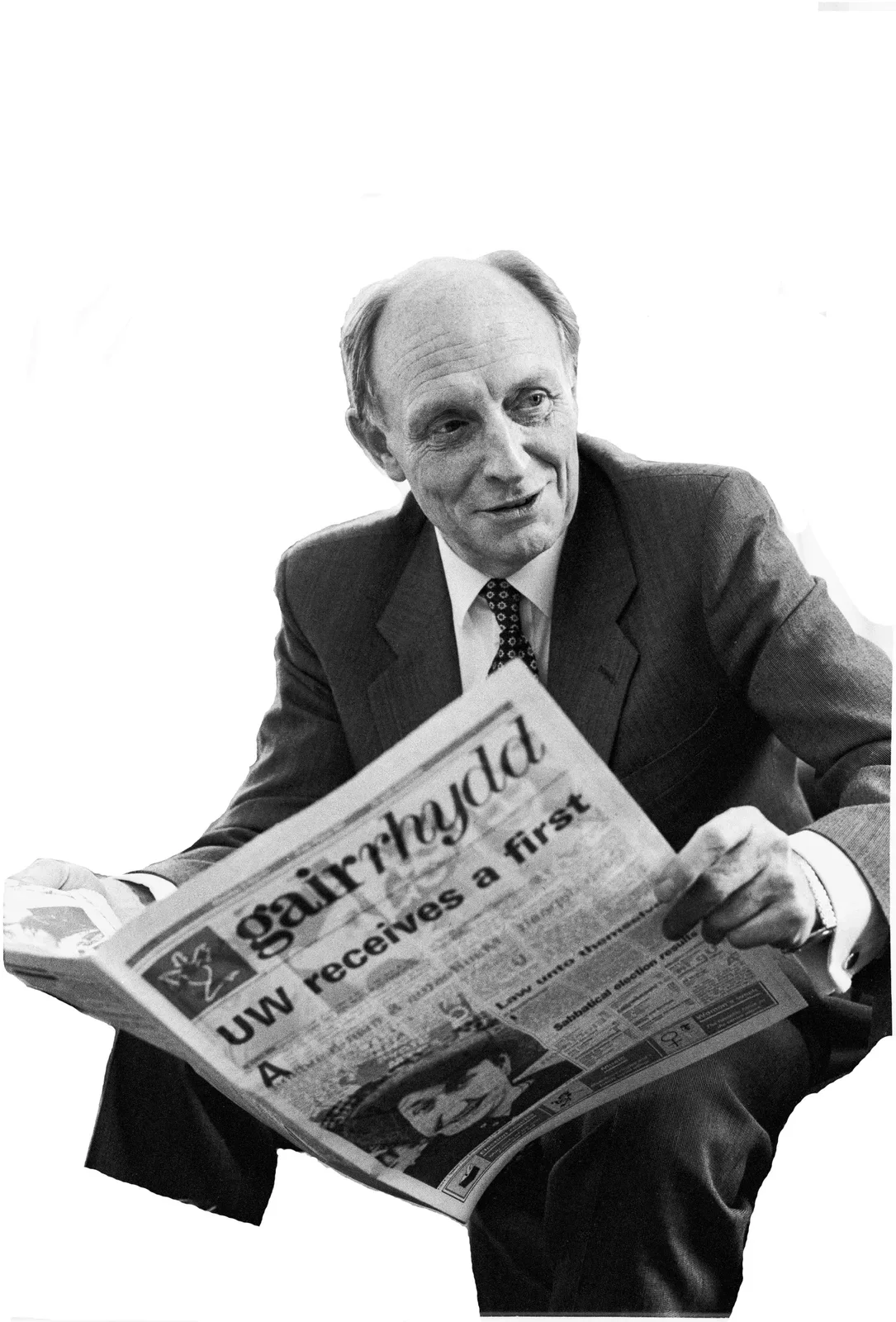
Now, winning comes in a lot of sizes. If I manage to secure housing for a family that were ill housed, or a pension for a war veteran who wasn't getting a pension, or a Social Security benefit for an invalid or an elderly person in need, that was a win. I fully enjoyed that.
I got very frustrated by the reality that because we so often had a Tory government, with laws that didn't take the people that I was representing in the proper account, that I wasn't winning enough. Then, of course, I became the Leader of the Party, and I was defeated twice. The second time, very marginally.
The bottom 11 Conservative majorities, when John Major got a majority of 21 in the House of Commons, totalled 1,240 votes. So it was narrow. But it's not winning.
It's coming second and it meant that we didn't get the democratic power to make the changes that would have benefitted the country. They had to wait another five years for those policies. “But what about youngsters who are thinking about becoming active in politics? Do it.
Our democracy depends upon it. You will feel justified in doing it. You also have some fun, which is very important and you might be able to contribute to the progress that you're seeking.
But don't think of it ever, not for one millisecond as a career. As a vocation? It's got to be a vocation and if you're going to get elected to anything, you can do a lot of hard work, you can gain a lot of respect, you can manifest your talents: you can do all kinds of wonderful things.
But if you don't get lucky, it's not going to happen. So a hell of a lot of it is luck and as long as you understand that and are still willing to try to stand up for your fellow men and women, then you should get engaged in politics. If you're doing it for yourself, please do something else.
Take up disco dancing or fly fishing, it's less harmful. There are too many people around who really do fulfil or validate the description of politics as being ‘showbiz for ugly people’. One of those is too many.
So, it's much better when people are trying to “do good”, because it is a hell of a sight better than doing harm. And it's even better than doing nothing. Neil Kinnock thank you very much.