
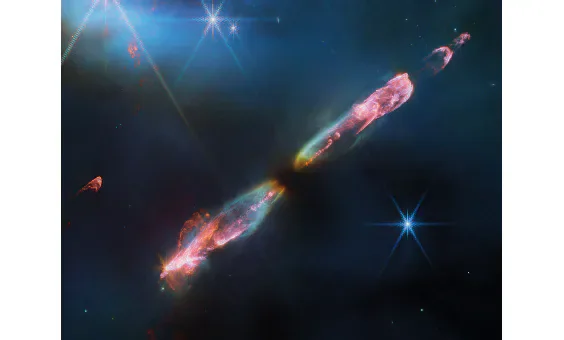
Behold the cosmic wonder that NASA’s James Webb Space Telescope (JWST) captured! Witness the breathtaking birth of a new star, HH 212, near the famous Orion constellation. At an estimated age of 50,000, this astronomical wonder remains obscured by a dense disk of gas and dust. A stunning, high-resolution image displays the vibrant pink-red jets shooting in opposite directions. It shows the energetic processes surrounding a Class 0 protostar to our Sun’s early stages.
The photo reveals the complex hop of Herbig-Haro objects —luminous areas that form when stellar winds collide with nearby gas and dust, producing shock waves. What sets this image apart is the deployment of infrared imaging by the James Webb Telescope, enabling scientists to penetrate the veils of obscuring gas and dust and explore the star’s outflows with unparalleled clarity.
The image highlights bow shocks to the southeast and northwest, accompanied by a narrow bipolar jet powering them. The inner jet’s symmetrical movement could be due to an unresolved binary star system. It is worth noting that the James Webb Telescope’s observations have a 5 to 10 times higher spatial resolution than any previous images of HH 211, which provides an unparalleled opportunity to observe this cosmic event.
Prior ground-based telescope observations had unveiled giant bow shocks and cavity-like structures in shocked hydrogen and carbon monoxide. The James Webb Telescope’s new findings reveal that HH 211’s outflow is comparably slow, challenging previous assumptions about protostar evolution.
Velocity measurements of the innermost outflow structures, ranging from 48 to 60 miles per second, indicate that the outflows from the youngest stars are predominantly composed of molecules. Unlike more energetic processes that break down molecules into simpler components, the lower shock wave velocities in HH 211 do not lead to molecular disintegration.
NASA released an article on September 13th that showcased the impressive capabilities of the James Webb Space Telescope. The telescope’s high-resolution, near-infrared view of Herbig-Haro 211 provides a detailed look at the outflow of a young star, offering stunningly intricate insights.
As the world’s premier space science observatory, the James Webb Space Telescope, led by NASA in collaboration with the European Space Agency (ESA) and the Canadian Space Agency, continues to unravel the mysteries of our solar system and beyond.
This groundbreaking image, visible near the easily seen Orion constellation, promises to deepen our understanding of the universe’s structures and origins, offering an unprecedented glimpse into the cosmic ballet of creation.