
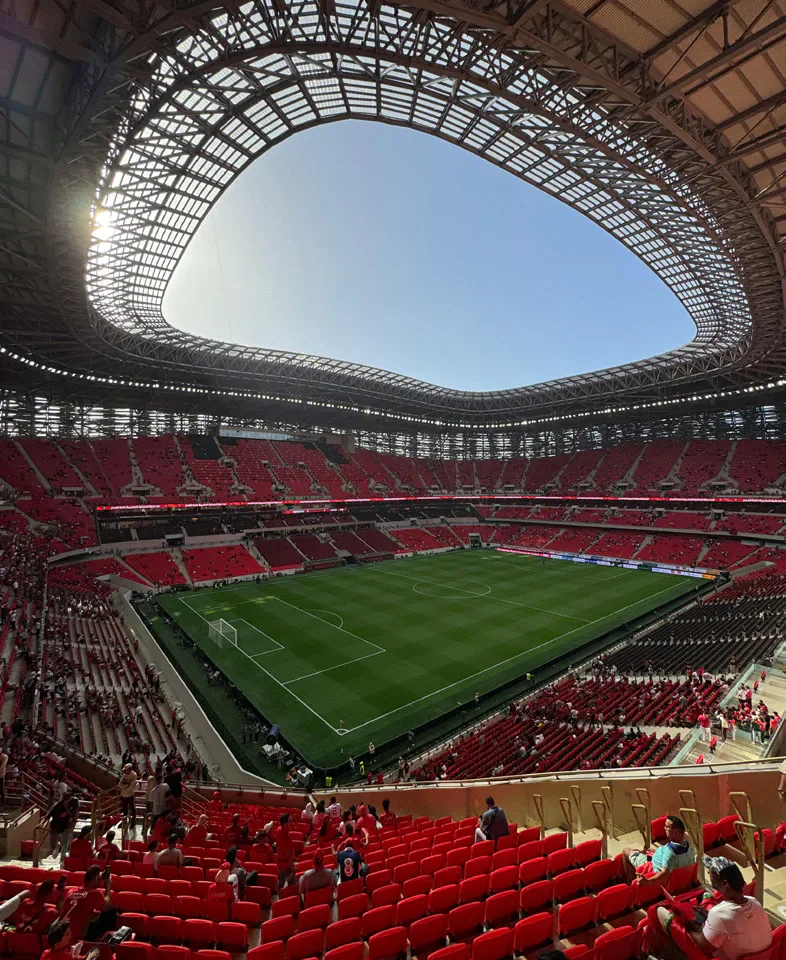
In late September, crowds of young Moroccans filled the streets of Rabat chanting, “We want hospitals, not stadiums.” Thousands of young people across at least eleven cities have rallied under the banner of Gen Z 212. A leaderless online collective, they demand investment in healthcare and education, denounce corruption, and challenge government spending priorities, as billions are poured into preparations for the 2030 World Cup.
The protests have exposed widespread frustration with poor public services and deepening inequality. At their core, they highlight the growing divide between Morocco’s ambitious modernisation projects and the unmet needs of its citizens, posing a serious political test for the monarchy ahead of royal sucession. The protests reflect years of frustration over failing public services, limited opportunities, and widening inequality that have left many young Moroccans feeling excluded from the country’s development.Morocco’s health system suffers from chronic underfunding and staff shortages, with fewer than eight doctors per 10,000 people and significant disparities between urban centres and rural communities.
Education faces similar challenges: inadequate rural infrastructure forces students to travel long distances,while frequent teacher strikes have disrupted schooling nationwide. Economic pressures intensify these grievances, with youth unemployment reaching 36% and more than half of under-35s saying they have considered emigrating in search of better prospects. Against this backdrop, government spending on highprofile infrastructure projects, including stadiums for the 2030 World Cup, has deepened feelings of neglect.
Whilst Morocco has invested heavily in modernisation, these projects haven’t improved everyday access to hospitals, schools or jobs. Frustration boiled over after eight pregnant women died in an under-resourced hospital in Agadir, alongside slow earthquake recovery and rising living costs. While protests are not new in Morocco, the current mobilisation stands out for its scale, organisation and demographic base.
Previous movements, from the 2011 Arab Spring demonstrations to the 2016–17 Hirak Rif protests and more recent strikes by teachers and medical students, were largely confined to particular regions. The state managed these through targeted concessions and repression, preventing discontent from spreading. At the centre of the protests is Gen Z 212, a decentralised collective organised through Discord that emerged in mid-September.
Lacking formal leadership or ties to political parties, it has relied on social media to synchronise protests across multiple cities with striking efficiency. This mode of organisation signals a shift in how political mobilisation is taking shape among Morocco’s youth: rather than channelling demands through established parties or unions, young people are constructing alternative digital spaces that operate outside the traditional political sphere. Similar digital movements elsewhere, such as Nepal’s youth uprising earlier this year, highlight how Gen Z is using technology to reshape political engagement in contexts where formal avenues are limited or distrusted. “Freedom, dignity and social justice” is echoed across the country as demonstrators called for improved public services, accountability for corruption and the resignation of Prime Minister Aziz Akhannouch.
An open letter addressed to King Mohammed VI urged him to dissolve the government and release detainees. Their demands were formalised in a letter to King Mohammed VI, which called for the dissolution of the government and the release of those detained during the demonstrations. The authorities initially met these calls with mass arrests and violent clashes that left three people dead near Agadir.
As the protests continued to grow, officials adopted a more conciliatory tone, promising dialogue and faster reforms, although little of substance has materialised. As of 5th October 2025, the protests have entered their eighth consecutive day. Gen Z 212 has continued to emphasise peaceful mobilisation, sustaining momentum through coordinated online campaigns that bypass state-controlled narratives.
How the monarchy responds to this sustained pressure will be a test of its political adaptability ahead of a sensitive royal succession.