
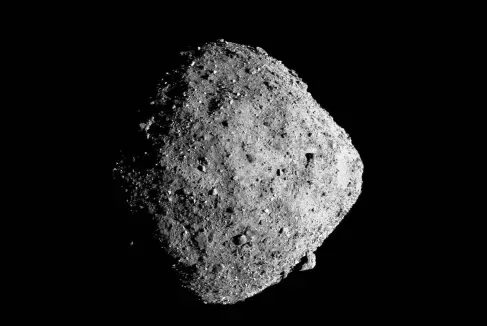
In a historic celestial rendezvous, NASA has successfully delivered samples from the mysterious asteroid Bennu to Earth, landing in the West Desert of Utah. This achievement is a significant milestone in our quest to unravel the secrets of the universe.
Asteroid Bennu, recognized as one of the Solar System’s potentially hazardous celestial bodies, was visited by the Osiris-REx spacecraft in 2020. A safe return of the capsule has been eagerly awaited for its potential to reveal Bennu’s composition and provide invaluable insights into the history of our cosmic neighbourhood.
The descent of the capsule, aided by a precisely engineered heatshield and parachutes, demonstrated high precision and technological prowess. The capsule’s landing was described as an elegant touch by Tim Priser, Chief Engineer at Lockheed Martin. The payload may appear light, at approximately 250 grams but for NASA’s analytical purposes, this is a substantial quantity. Eileen Stansbery, Chief Scientist at NASA’s Johnson Space Center, highlighted the potential for detailed microscopic analysis, offering a unique glimpse into our Solar System’s history.
Preserving the sample’s integrity was of utmost importance and swift transportation to a temporary clean room at the Dugway army base was imperative to shield against potential Earth contamination. The capsule’s disassembly was a carefully executed procedure, culminating in a secure placement within an inner canister.
Preserving the sample’s integrity was of utmost importance and swift transportation to a temporary clean room.
The sample will soon be transported to Johnson’s specialized facility, where a team of experts part of the “Quick Look” team including UK scientist Ashley King, will conduct the initial assessment. They anticipate encountering a delicate, clay-rich material that may hold traces of water and carbon compounds from epochs long past.
“I think we’ll probably see carbonate minerals, and maybe some things we call chondrules and also calcium-aluminium inclusions, which were the very first solid materials to form in our Solar System.” – Ashley King
The forthcoming press conference on October 11 promises to showcase initial insights from these cosmic fragments. We stand on the doorstep of comprehending the early days of our Solar System, as the scientific community awaits the revelations that may reshape our understanding of the cosmos.
Consider this: each discovery in space science is a testament to human curiosity and scientific ingenuity.