
Trump’s recent re-election has evoked a sense of déjà vu from 2016, when once again using hardline policy agendas and a zero-tolerance approach has gained him political power, promising to restore America to its former glory through radical policy shifts. The issue of migration has played a big part in his electoral gain, with “securing the border” being a salient issue for many voters.
Trump is hardly shy when it comes to his attitude towards immigrants; in fact, he is passionate and proud when he classifies them as “illegal aliens” proclaiming they are “poisoning the blood of our country”. Such rhetoric has obviously worked. With his 277 electoral college votes and the Republicans taking Congress, he has identified a key policy area on which he could take ground and use his personal ideology to help reinstate him as the 47th president of the United States.
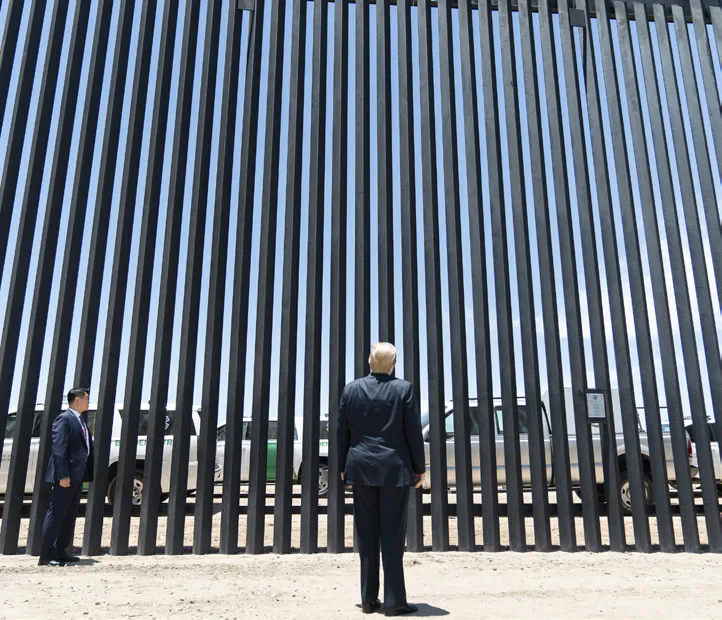
It is reminiscent of Trump’s original election campaign in 2016, where he promised increased border patrols, deportations, and increased funding for US Immigration and Customs Enforcement (ICE), and it is clear we are heading the same way again. The first Trump administration made headlines almost instantly, with policies such as the colloquially dubbed “Muslim Travel Ban” and his infamous wall across the border with Mexico.
Trump joyously uses his political rallies as events to foster enthusiasm and passion for his proposed plans. Often coupled with adoring chants, screams, and tears, virtually every word that comes out of his mouth is gobbled up and lovingly cheered for. His plans for the border became progressively more extreme the closer he got to election day. Trump has promised to deport as many as 20 million people across the border through legislation such as the so-called Alien Enemies Act of 1798, alluding to the potential use of US military troops and archaic 18th-century wartime powers.
Economically and practically, would this even be possible? Researchers looking into his pledges have said his vision has severe constitutional obstacles in his path, making it potentially impossible for him to achieve his vision within a four-year term. The immigration system is already inundated with legal challenges, and with JD Vance promising to deport 1 million immigrants annually, this would amount to a staggering $967.9 billion over a decade, according to the American Immigration Council.
Logistically, mass deportations could send shock waves through the economy and workforce. According to the Pew Research Center, in 2022 undocumented immigrants made up 5% of the workforce, filling in vital roles that otherwise wouldn’t be filled by other US citizens. This vacuum of labour would create knock-on effects and a gaping hole in the economy that would struggle to be filled.
President-Elect Donald Trump will be inaugurated on the 20th of January 2025, and only then will we get a clearer idea of what legislation exactly will be implemented, removed, and changed. Right now it is up in the air, but it is probable that the United States will see a return to the zero-tolerance approach and extremist anti-immigrant attitudes and policies. From his adoring fans and conservatively-packed Supreme Court, he has a huge amount of popular and political power. It is very likely he will push this to the absolute limit; Trump controls both halves of a partisan Republican Congress, and will likely reclassify and fire tens of thousands of “disloyal” civil servants in the federal government who would have refused to enact his will, replacing them with loyalist political appointees who have pledged to support the Republicans’ every whim. Donald Trump is at liberty to implement his migration agenda in basically any way he likes.