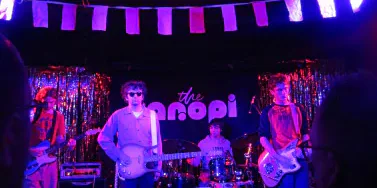
At Sŵn Festival, the city itself becomes part of the line-up.
One minute, you’re squeezing into a tiny room to catch an up and coming folk artist, and the next you’re sprinting across Cardiff in hopes you’ll see the packed out headline set at Tramshed.
With over 100 bands, one ticket, and probably 20,000 steps, it’s far from a relaxing day out, but that’s all part of the appeal. Perhaps the most discernible trait about Sŵn is the chance to discover Cardiff just as much as the music.
Spanning all the way from Womanby Street in the city’s centre to venues closer to Principality Stadium, the festival takes audiences to places beyond their usual range.
For example, I stumbled across The Canopi, a grassroots community space with a coffee bar at the front; and intimate space for gigs tucked in the back, down Tudor Street.
Standing at the back of the room watching an artist I hadn’t heard of perform in a place I’d never been to before, really encapsulated the essence of Sŵn to me: finding something special in a place you wouldn’t expect it.
That sense of discovery extends to the line up too. By bringing artists of all sizes into independent venues across the city, Sŵn gives emerging musicians the chance to reach new audiences and listeners the opportunity to stumble upon a new act through taking a chance on an unfamiliar set.
Dove Ellis’ set was a particular highlight for me, his hauntingly visceral songwriting paired with a voice reminiscent of Jeff Buckley.
There was definitely something exciting about walking into a gig with no expectations and leaving having discovered an artist I couldn’t wait to check out on Spotify.
Looking at the student side of it, Sŵn also offers impressive value for money. My £45 student ticket enabled me to see seven bands in one day, coming out at roughly £6 per act, including the headlining favourites Westside Cowboy.
Sŵn has this distinct advantage in comparison to attending an individual gig, you get a shorter set, but for a fraction of the price.
With opportunities to volunteer in exchange for festival access, it also offers ways to get involved beyond the standing in the audience.
But, of course, the experience isn’t flawless.
Clashing set times and walks of up to twenty minutes between venues can become frustrating and tiring as the day progresses. Similarly, you risk the chance of turning up to a performance that’s already full.
At Fuel, securing a view for Die Twice from the back was almost impossible due to the mix of a packed-out crowd, low ceilings, and a sea of people over six feet tall.
Still, these drawbacks are part of the compromises made for a festival that spans citywide. It hosts valuable opportunities not just for audiences and artists, but for venues too.
With the recent closure of District, the sustainability of Cardiff’s independent music scene has been questioned, as yet another live music space disappears from the city’s streets.
Alongside soaring business rates, rising operating costs, and the wider pressures facing the late night hospitality industry; independent venues are becoming increasingly vulnerable.
It emphasises the importance of multi-venue festivals like Sŵn and its ability to introduce audiences to new spaces, helping sustain the venues that give the city its musical identity.
More photographs