
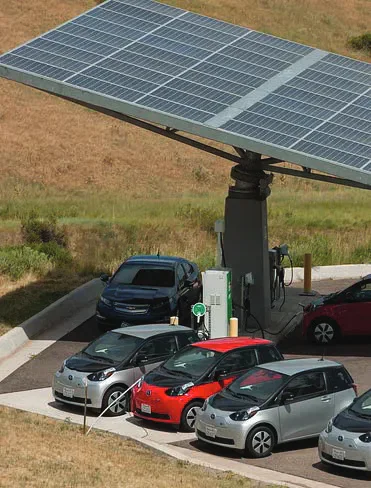
In 2023, a European Union proposal to ban the sale of combustion engine cars from 2035 was delayed by Germany, whose last-minute campaign insisted on an exemption for synthetic fuels, also termed “e-fuels”, much to the chagrin of the other member states. Given the country’s huge auto-manufacturing sector, and its petrol-head populace, this was hardly surprising. Nor was it particularly a shock when the EU mostly buckled to Germany’s demands and allowed the exemption.
Many commentators have suggested that synthetic fuels—made by combining carbon dioxide with hydrogen, which can be synthesised with minimal CO2 emissions if so-called ‘green hydrogen’ is used—could displace electric vehicles (EVs) as the dominant mode by which automotive transportation is to be decarbonised. This technology has been hailed as a superior alternative to EVs, as it can be used in most existing combustion engine vehicles, meaning that the sizeable embedded emissions of the production process of electric vehicles, as well as much of the environmentally and socially destructive effects of its requisite mineral mining, could be avoided entirely. Though others, whose views I find far more persuasive, have argued that this has primarily been a ploy by fossil fuel interests to prolong the manufacture of combustion engine vehicles, and thereby the use of fossil fuels for transportation.
To give them some credit, the EU did seem to have shared this perspective with me, as they ultimately did partially challenge Germany’s goals by stipulating that the exemption apply only to "such vehicles [with] technology that would prevent them from driving if other fuels are used", which if enacted properly would avoid the worst-case scenario of Germany’s campaign— the prolonging of the sale of cars powered by fossil fuels at a time in which the decarbonisation of the transport sector (currently responsible for 20% of global emissions) is more pivotal than ever. This does mean, though, that those purported benefits of synthetic fuels, the possibility of their use in existing vehicles, are now entirely moot.
So, what’s the problem with this? If the EU has made sure that there is still a ban on new fossil fuel-powered vehicles by 2035, with only low-carbon vehicles allowed to be sold, then what am I complaining about? This is the part where I argue that the exemption for synthetic fuels is a colossal failure in climate action, and that Germany has once again proven itself a nuisance for achieving the EU’s climate goals by challenging the initial proposal. Synthetic fuels suck. They are terrible. This is not just because of the not-so-unlikely possibility that many jurisdictions will simply produce these fuels without the necessary ‘green hydrogen’ needed to make the process more sustainable, but also because even in a paradisiacal world where all electricity and hydrogen is produced from low- or zero-carbon sources, they are vastly worse than electric vehicles.
Even if we assume 100% clean energy and hydrogen, according to the European Federation for Transport and Environment AISBL, the sheer inefficiency of the combustion engine leads to an overall system efficiency from wind turbines to the car’s wheels of 17–20%, compared to 77% for entirely electric vehicles. Even factoring in their production, synthetic fuels emit more CO2 than EVs (55% more according to the Transport & Environment NGO). On top of that, even if entirely ‘green’, they are extraordinarily inefficient to produce, requiring absolutely insane amounts of energy compared to EVs. According to Carbon Brief, running all of the UK’s cars on ‘e-fuels’ would require five times more electricity than if they were EVs. All these cars alone would require more electricity than the UK uses in total right now. What a genius climate policy!
Even if you deny climate change altogether this would be an astronomically stupid proposal based on the sheer expensiveness of synthetic fuels alone. According to the IPCC, they are up to three times more expensive than even conventional fossil fuels. Furthermore, synthetic fuels do next to nothing to reduce air pollution, as they do not reduce pollutants such as NOx, carbon monoxide, and fine particulates, all of which are hazardous to health and the environment. There is probably no place for synthetic fuels in transportation, no matter what fuel companies and car manufacturers like Porsche may say. All their implementation will do is drastically increase the demand for renewable energy for transportation, which would avoidably complicate the already challenging transition to a more sustainable electricity grid.
Thankfully, in the United Kingdom, the lobbying efforts of fossil fuel interests to eschew EVs for synthetic fuels, have been largely ignored. The government rejected these fuels on the basis that they were “expensive”, “not proven”, and because of their failure to sufficiently reduce air pollution. Let us hope that this remains the case going into the future, so we can live in a world where cars don’t kill us quite as much as today. Because while electric vehicles are very far from a silver bullet solution to our emissions problem, they remain a necessary component in the decarbonisation of the transport sector, particularly in countries whose existing car-centric infrastructure makes the transition to the even more sustainable ideal of as few cars as possible far less likely.
The climate transition is going to be a rocky one, and some sectors and individuals are going to feel vilified for their inaction, and while it is important to remember that we all have a shared responsibility to change our unsustainable Western ways, it is important to keep things in perspective. No one is going to take away your right to drive a car anytime soon. All that is being asked is a shift from a stinky, inefficient, polluting, and world-heating hunk of metal to one that isn’t quite as damaging to the planet we live on. Doesn’t seem like such a major imposition to me, given the scale of the climate crisis. Avoid action now, and the impositions on our lives are only ever going to get worse. Let’s all avoid a temperature rise scenario where things get so bad that nobody is allowed to drive at all by saying goodbye to the combustion engine today. Its time is done. Thank you old friend. Let’s get electric.