
Bustling about Cardiff, it can be easy to miss the myriad of public art projects scattered around the city. With Cardiff’s rich history filled with important public figures and events, the statues that adorn our streets hold stories that are worth taking a moment to think about.
Betty Campbell (1934–2017) Central Square
If you’ve ever walked to JOMEC or from the train station up towards St Mary Street, then you’ve almost definitely passed the huge bust of Betty Campbell. Commissioned after a BBC “Hidden Heroines” poll, the statue tells the story of the first black head teacher. Her impact in life was palpable.
Campbell’s determination from a young age to become a teacher and make an impact in education despite people telling her not to bother was inspirational. She used her position to teach black history and even contributed to the founding of Black History Month. Alongside her impacts during her lifetime, her statue itself marks an important moment in Welsh history. Hers is the first statue of a non-fictional woman in Cardiff. Her legacy will live on through this poignant sculpture of Campbell surrounded by children—demonstrating the success of her career and activism both in life and posthumously.
John Batchelor (1820–1883) The Hayes
Liberal politician John Batchelor made waves in Cardiff through his strong opposition to the Bute family. He eventually became mayor of Cardiff, among other roles, and earned the title “Friend of Freedom, which marks his statue.
His work as politician provided Cardiff with effective sewage and drainage, and a school for poorer children. He also broke the Bute control of coal trade and provided more opportunities for the business owners of Cardiff. The statue itself was raised from donations of £1,000 and unveiled on a Saturday so that the working population, those who Batchelor had impacted most, could attend.
However, the Conservative force in Cardiff petitioned to remove it and defaced the statue three times within two years. His political standing as a voice to the people proved controversial to the opposition, but to the working class of Cardiff, Batchelor was more than worthy of a statue for the representation he gave them.
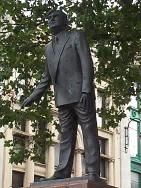
Aneurin Bevan (1897–1960) Queen Street & David Lloyd George (1863–1945) Gorsedd Gardens
Two high-profile Welsh politicians of the 20th century who are often compared to one another both have statues in Cardiff: Aneurin Bevans, creator of the NHS, and David Lloyd George, the first and only Prime Minister from Wales.
While both men were radical, liberal politicians, they often did not see eye to eye when their paths crossed. When you take a look at their history, you see two different experiences of Wales. Lloyd George, a Welsh-speaking non-conformist who lived in north Wales and was thoroughly educated.
Bevan, was a non-Welsh speaker from the valleys who grew up in a working-class environment and worked as a miner. Their statues in Cardiff solidify their common positions as powerhouses of British politics who invigorated Wales with a sense of nationalism. Despite their differences, both men were advocates for liberal policies and supported Wales through their careers. The statues immortalise them both as having moulded the Wales we live in today.
Many protests and processions begin at the foot of Aneurin Bevan’s likeness. While these four statues highlight some of the more notable characters of Welsh history, there are so many more in the city to find. Public art is a constantly growing medium which displays people and ideologies relevant to both the past and the present. Statues like From Pit to Port and People Like Us in the Bay are just as important for telling the stories of Welsh people and heritage.
I encourage you on your next walk around the city to take a moment and view some of these sculptures and read their inscription. The often underrepresented history of Wales, its people, and its culture can be told through the statues of Cardiff that you walk past every day.