
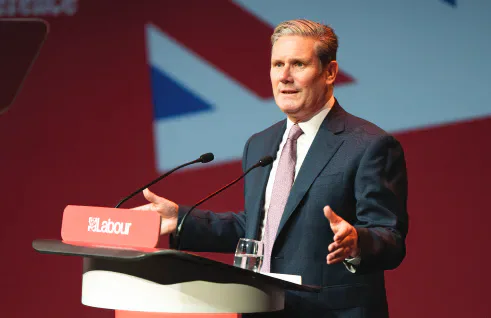
On the same day we found out that global warming exceeded 1.5C across an entire year for the first time ever, Labour leader Sir Keir Starmer announced he will no longer be committing to his £28bn ‘Green Prosperity Plan’. The spending pledge, initially announced in 2021, was celebrated for striving the UK in the right direction towards reaching important climate targets, as well as creating new green jobs and reducing household bills. The defining aspect was the creation of a state-owned energy company which would see the country invest in more renewable sources of power, such as offshore wind farms.
This would allow the UK to reduce its reliance upon unreliable fossil fuels, removing the ability of energy-producing countries to monopolise on their fossil fuel exports for political gain, reducing geopolitical tension and spikes in energy prices like the ones we have seen as a consequence of the Russia-Ukraine war. It would also help reduce the UK’s contribution to climate change, as well as reducing household bills, with wind energy being nine times cheaper than gas.
The UK also has some of the oldest and draughtiest housing stock in Western Europe, and the Green Prosperity plan aimed to tackle this by providing up to £6bn a year on loans and grants for families to improve home insulation. It also included funding to aid the development of electric vehicles, improving transport infrastructure and the decarbonisation of British industries. The hefty £28bn was set to be funded from borrowing which, at the time of initial unveiling, was a largely uncontroversial statement as interest rates sat at an attractive 0.1%.
Since then, they have soared to a whopping 5.25%. This drastic change in economic situation has thus caused concern about the financial implications of the plan, coupled with Starmer’s fear of the recurring narrative being parroted by the Tories that Labour cannot be trusted with the publicfinances. For months now there has been an intense debate within the Labour Party over whether or not to water down the target, but on Th ursday Starmer fi nally decided to pull the plug.
The U-turn was met by a sea of criticism from many environmental groups, including ‘Just Stop Oil’ who accused Labour of being “complicit in killing millions”, as well as ‘Friends of the Earth’ who warned that cuts would be “short sighted and cost the country dearly”. The announcement was also condemned by both sides of the political spectrum, with a spokesperson for the left-wing campaign group Momentum saying: “This latest Starmer U-turn represents yet another capitulation to right-wing interests.” Prime Minister Rishi Sunak also joined in, commenting: “This is a serious moment. This was the flagship plan of Labour’s economic policy and it now looks like he’s trying to wriggle out of it.
I think it demonstrates exactly what I’ve been saying, that he U-turns on major things, he can’t say what he would do differently because he doesn’t have a plan. If you don’t have a plan, then you can’t deliver change for our country.” It’s clear that Starmer made a big mistake by attaching such a hefty pound sign to one of his key missions, and perhaps that’s why all further pledges and policies he’s made since then have been so vague. He’s learnt the hard way that making such a bold promise to people two years before the election is not the brightest idea.
The £28bn figure had thus become a millstone around the neck of the Labour Party every time they tried to portray themselves as fiscally disciplined. Reeves is keen to be taken seriously as chancellor, but is abandoning her most distinctive policy the best way of doing that? All Labour want to do is win this general election, and they’re evidently trying to remove every unpredictable element that might derail the campaign in order to do so.
Two years ago, when the policy was first announced, Labour was keen to define themselves as distinctive and different from the Tories in their bid to win votes. Yet their strong lead in the opinion polls, paired with the current chaos of the Conservative government, indicates that Labour doesn’t need such drastic ideas in order to win anymore. Despite vowing to be Britain’s first “green chancellor” if Labour wins the election, Reeves has turned her back on the environmental policy she helped create.
Is this a responsible and sensible decision by Labour which demonstrates their ability to protect the public purse? Or is this just yet another example of them backpedaling on a key Labour policy?