
Rarely does a three-and-a-half-hour period drama live up to its hype, but Scorsese delivers a thoughtful and masterfully executed piece of cinema with spellbinding performances across the board.
Killers of the Flower Moon can easily be compared to fellow recent historical drama Oppenheimer, the pair clocking in at a gargantuan 386 total minutes. Both combine direction from one of the most celebrated auteurs in cinematic history with a stellar cast of renowned actors, immediately allowing for a sweep at the Academy Awards next year. However, Oppenheimer comes across as somewhat generic compared to Scorsese’s refreshingly unconventional take on the revisionist Western.
The film’s editing is an obvious highlight: it creates a jarring, fast-paced environment for Scorsese to thrive in. Jarring cutaway shots depict the brutal murders of the Osage population as nothing more than a second thought, reflecting the indifference to the genocide taking place felt by the film’s white characters.
A wonderfully creative epilogue in the form of a radio show (starring Scorsese himself ) makes the deliberate choice to leave the audience unsatisfied with the film’s conclusion. Inter-titled, monochromatic reels emphasise the divide between Oklahoma’s Osage and white citizens; the Osage are consistently depicted as nothing more than inferior spectacles, accepted purely due to their wealth — setting the tone perfectly for the film ahead.
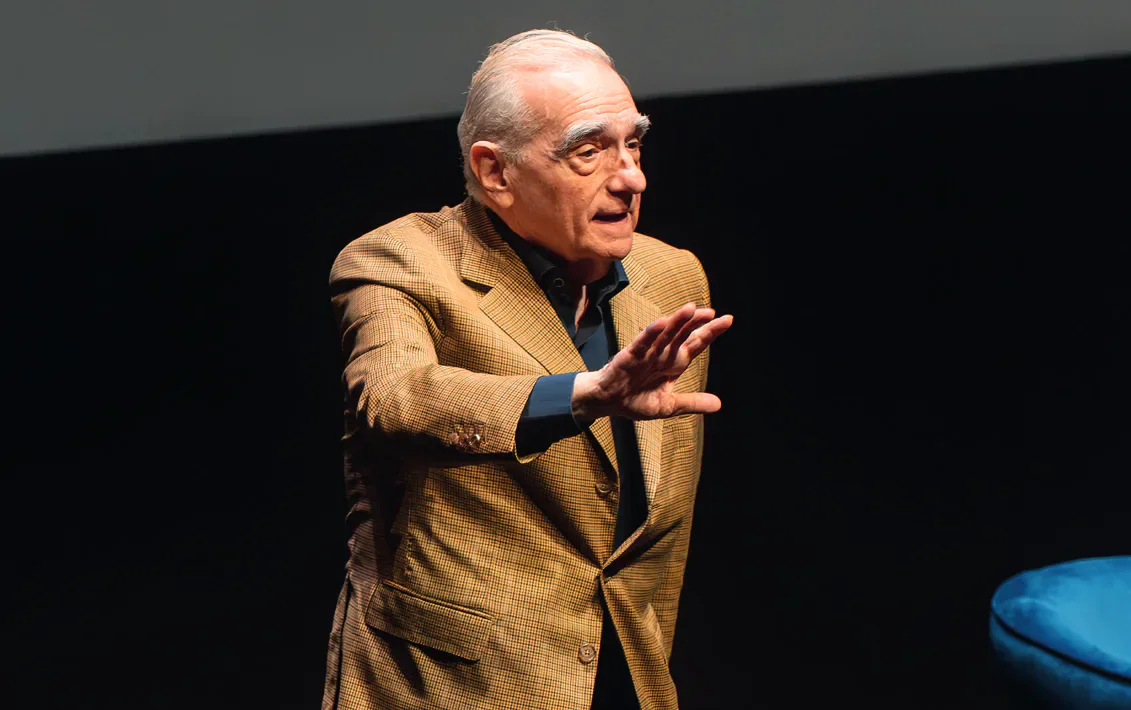
This, combined with impeccable sound design and practical effects, shows the extent of Scorsese’s prowess as a director. Here is a man who has been honing his craft for over 60 years, and it absolutely shows. Despite the longevity of his career, Scorsese still shows obvious passion for his craft. Killers of the Flower Moon is a fast paced, tightly run ship with no room for mistakes.
Here is a man who has been honing his craft for over 60 years, and it absolutely shows.
Ironically, if there was any aspect of the film I could change, it would be something that once again reminded me of Oppenheimer — only this time, in a negative way. Both utilise a line of dialogue in a way that I’ve only seen before in Marvel films; a famous character is mentioned in passing, only for one of the film characters to quip that they don’t know who they are, as they aren’t yet famous. Hilarious, right? With Oppenheimer it was the “young upstart John F. Kennedy”, with Killers of the Flower Moon it’s “J. Edgar Hoover — I’ve never heard of him”. This wink-wink-nudge-nudge to the audience is something that I can just about bear in a Marvel movie, but after Scorsese’s constant jibes towards comic book films, you’d think he would be above such an eye-roll of a cheap joke.
Of course, its cast was the film’s initial selling point, and it goes without saying that everyone involved was outstanding. Robert DeNiro doesn’t particularly step out of his comfort zone as the cold-blooded, immoral patriarch, but plays the part magnificently. Jesse Plemons’ cut-throat FBI agent brings a suavity reminiscent of Willem Dafoe in American Psycho.
Comic relief — whether intentional or not — appears in the form of an unexpected Brendan Fraser, who brings an energy to his role that I can only liken to the Kool- Aid Man. Leonardo DiCaprio is perfect as the ignorant, wolfish protagonist; he grimaces and stumbles through the film with an Oscar-worthy spinelessness. Unexpectedly, the best performance by far comes from relative newcomer Lily Gladstone, who steals the show with a perfect portrayal of a strong-willed Osage woman