
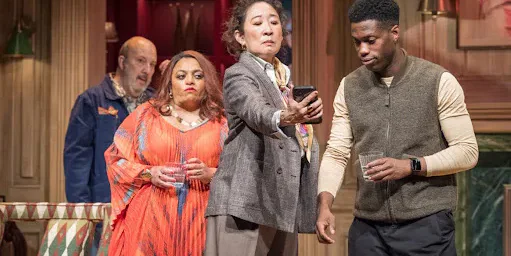
Martin Crimp’s masterful reimagining of Moliere’s 1666 play, The Misanthrope, directed by Indhu Rubasingham, took hold of Lyttelton Theatre this summer and is soon to be screened in cinemas by National Theatre.
Crimp’s revival four centuries on drags the debate of flattery and French aristocracy into an era of ‘cancel culture’, mis- and disinformation and hypocrisy intertwined with flashes of radical feminism.
Rubasingham’s result is sharp, messy and consistently thought-provoking.
The recharacterisation of Moliere’s French aristocrat Alceste into Alice, a biting and fiery novelist played by Killing Eve’s Sandra Oh, unfolds on a set that blends baroque flourishes with a classic London townhouse dressed in contemporary, Oliver Bonas-esque furnishings.
Where Alceste raged against courtly flattery, Alice rages against John’s flattery to appease a woman whom he had forgotten the name of, despite John’s defence that it was offered out of moral duty in the opening scene.
Oh is flanked by a sharp supporting cast, with Paul Chahidi as John; Tom Mison as Stefan; Abigail Cruttenden as Claire; Imogen Elliott as Esmee; Rina Fatania as Indira; Freddie MacBruce as Allen; and Jemima Rooper as Elaine.
Oh plays Alice with coiled, stinging anger that toes the line of caricature.
Even as the production hangs on rhyming, lyrical dialogue that nods to its 17th century roots, Oh keeps Alice’s fury grounded in something painfully current.
A Berlin literary prize being withdrawn over a controversial remark; a recorded conversation between fan Esmee and Alice; cunning Allen’s recording of quotable material for a hit piece on Stefan; and Elaine’s twisting of a voice recording are all precise portraits of how the reception of words can outrun their intent, and how quickly reputation can be reduced and distorted.
The poignancy of the play comes through the coarse friction between female characters.
Despite Alice’s scathing remark, “male monstrous liars”, that breaks the boundary between audience and stage, her feminism seems radical as she snipes at Claire, Elaine and Esmee, dismissing them in turn as the controlling manager, the grasping ex-wife and the spoilt, talentless nepo baby.
These moments interrogate Alice’s contradictions as she claims a more radical feminism than the women around her.
Yet, the production is quietly sceptical, with Elaine’s rebuke about Alice’s freedom as a childless woman landing forcefully.
Stefan’s plot swallows a fair amount of stage time, becoming a wandering road that resolves in a bleak Moliere-echoing ending.
Rubasingham saves the production’s strongest image for last in a spectacular culmination of light, movement and colour.
It’s a moment far better experienced than described here. A masterful and ingenious production.
The Misanthrope comes to cinemas from 22 September with National Theatre Live. Find your tickets at ntlive.com.