
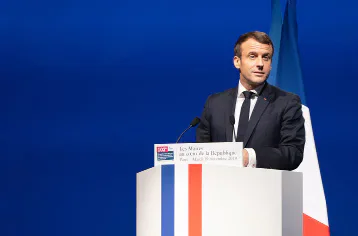
President Macron of France faces increasing pressure as his government (led by Prime Minister Lecornu) survived two no confidence votes on Thursday (16th October) by as little as 16 votes. Lecornu is now President Macron’s seventh Prime Minister across his two terms in office and his fourth in barely a year. What has led us to this point and why is Macron’s government facing such high parliamentary pressure?
In June last year, President Macron shocked many in France by calling for snap legislative elections and dissolving Parliament (following his party being crushed in the preceding EU parliamentary elections). This was in an attempt to gain a majority in Parliament to prevent the need to use Article 49.3 of the French Constitution (which allowed him to pass laws by decree, but which would lead to votes of no confidence in his government every time it was invoked). Much to his dismay, however, his Ensemble coalition lost 76 seats in these elections, with the left-wing coalition (New Popular Front) becoming the largest parliamentary party on 188 seats and former Presidential Candidate Le Pens right-wing National Rally coming third with 142 seats (despite getting the largest proportion of the votes with 37.1% of votes).
Why has this led to such a high number of Prime Ministerial resignations and how have we ended up with Lecornu? Immediately following the 2024 snap legislative elections, then Prime Minister, Gabriel Attal offered his resignation following Ensemble’s defeat. Just three months later, Attal’s successor Barnier was then toppled by a no confidence vote and forced to resign following the presentation of an austerity budget.
Lecornu was then appointed following the resignation of Barnier’s successor Bayrou due to another lost vote of no confidence. Lecornu, prior to his appointment as Prime Minister, had been defence Minister for 3 years and was known as a close ally to Macron. Lecornu himself has been forced to resign once following controversy as his first cabinet remaining largely unchanged from that of his predecessors, leading to most major parties to withdraw from budgetary negotiations.
He was however, after 4 days, reappointed and instructed his ministers to find a budgetary compromise. This Prime Ministerial ‘musical chairs’ arguably shows the lack of Parliamentary support for an Ensemble and Macron led government. However, the Lecornu government has managed to gain the support of the socialists after delaying his party’s controversial pension reforms until after the 2027 presidential elections.
This support was vital for his survival during Thursday’s no confidence votes, with only 7 members of the socialist party voting against Lecornu. It is not clear if this uneasy alliance will last however, as the socialists have called for a 2% wealth tax on the top 0.01% of wealth holders in France but several Macron-supporting centrist members of the Assemblée Nationale have shown a great deal of opposition to such a policy. With a hung Parliament and policy disagreements between members of Lecornu’s uneasy and non-binding Parliamentary coalition of centrists and socialists, what options are now left open to Macron?
Whatever Macron chooses he risks a more polarised government
He could resign, triggering an early Presidential election but with National Rally leading the national polls by 20 points (in a hypothetical first round of voting), he may fear this would essentially hand the presidency to the far right and when contacted, he refused to offer comment regarding the possibility of his resignation. He could call fresh legislative elections but again, he faces the possibility of a National Rally and him being forced to appoint a far-right Prime Minister as National Rally lead the polls by 10 points in Parliamentary voting intention polls. His final option is he could do nothing, and hope Lecornu can negotiate a budget without being removed.
Overall, whatever Macron chooses, he risks a more polarised government in an increasingly partisan France, leading to greater instability. France now looks to him to find a bipartisan solution to break the Parliamentary stalemate and to end France’s political instability.