Over the summer, UCU negotiations with Cardiff University management have neared collapsed. As a result, industrial action in the 2027 spring semester is likely (read more about this in News, page 6).
In May 2026, a staff survey, which has been leaked to Gair Rhydd, revealed
“almost 70% of participants voted negatively to the statement that “change is managed well at Cardiff University”.
Now November, Gair Rhydd have been contacted by staff from across the University to report their unaddressed frustrations and feeling that a “lack of emotional intelligence” among management is causing "irreparable damage” for years to come.
With such a disheartened staff body, and students also feeling the consequences of senior managerial decisions, what do students need to know about why Cardiff University staff have been pushed to this point?
Voluntary Redundancies
When cuts were announced in January 2025, voluntary redundancies were offered across schools as late as July. While this form of redundancy was optional, an anonymous lecturer from the College of Arts, Humanities & Social Sciences expressed to Gair Rhydd that “it was forcing people to make decisions that they might not have necessarily made in a different framework”, another describing it as a waiting game for “who might blink first”.
What’s worse, the pressure put on academic staff to take redundancies has also affected groups differently.
"About 80% of ENCAP voluntary redundancies were taken by senior female lecturers,"
and a separate anonymous staff member shared that, in their department, voluntary redundancies were
"“more likely to be taken by academic staff from ethnic minority groups”".
Consequently, this has “an impact on the diversity of what you can teach”, and with no budget to hire, there is no financing for the “prospect of replacement”. For example, History no longer teaches Indian history, and has no academic to supervise American history dissertations.
In a 2026 internal staff survey conducted by Cardiff University, leaked to Gair Rhydd, 20% of participants voted negatively to the statement that “Cardiff University is making progress on creating a more diverse and inclusive place to work”. As pressure to take redundancy in Spring 2025 mounted, it is clear that these redundancies had no thought for how consequences may vary by class, gender or ethnicity.
While some might have hoped employment stresses subdued as redundancies were taken off the table, academics and professionals at Cardiff University have been faced with complete restructuring of their roles.
Academic Delivery Model
In 2026, lecturers were provided with an ‘Academic Delivery Model’ where senior management asserted new guidelines for the time lecturers should commit to various tasks. An anonymous lecturer in the School of Global Humanities told Gair Rhydd that jobs they have always done are “all of a sudden allocated less hours, so that they can give us more to do”
"Additionally, this model has imposed a tremendous cut in research hours, from 40% of contracted hours to 20%"
(read more about this in News, page 3). While 40% is the current average benchmark of research hours for universities across the country, lecturers are now expected to deliver cutting edge, research-led content to students with less time.
In an interview with Dr Ann Heilmann, professor of English Literature at Cardiff University, she claimed that staff across various departments are “very, very stretched”, as
"senior management have "stripped out the time to think", they've "stripped out the time to teach""
and to “be as responsive in pastoral care as we should be in personal tutoring”. Additionally, she noted that for a long time, “universities [have] only work[ed] because people are fulfilled by their jobs and prepared to do way more than their contract stipulates”.
If industrial action does take place, academic staff may only work their contracted 35 hours: inevitably leaving many tasks incomplete, emails unresponded to and directly affecting the quality of students’ education on every level. Unfortunately, it may take a total strike for management to fully realise their perseverance. Dr Andy Williams suggested that “this place runs on goodwill”, and, as staff continue to face such adversity, “there is no goodwill left”.
Wellbeing Support and a Looming Mental Health Crisis
As a consequence of lecturers’ overloaded timetables and unreasonable working hours, staff across academic and professional services report feeling incredibly stressed and overwhelmed. In the 2026 survey,
"over 25% of respondents voted negatively to a statement that they are able “to cope with the stresses” of their jobs"
and that they receive appropriate support for their mental wellbeing. Almost 40% voted negatively to the statement “I am able to manage my workload without regularly working unreasonable hours”.
When the survey was sent out in May 2026 to staff, an accompanying article commented that the University Executive Board is “committed to responding to these results in a concrete way”, promising to address concerns regarding “Workload and Wellbeing”. Yet, as late as November,
"Gair Rhydd is told of “unsustainable levels of staff going off sick with mental health issues due to stress at work”."
While management does provide counselling services for struggling staff, multiple lecturers have come forward alleging that queues for these provisions have had waitlists of multiple months since the cuts were first announced in 2025.
It has been nearly 6 months since this survey results were released, and senior management’s “commitment” to improving staff wellbeing seems to have made little tangible change for our lecturers. In June 2025,
"Wendy Larner, Vice-Chancellor, spoke at the Senedd, where she stated that "the majority" of poor staff wellbeing and mental health "refers to personal, not workplace stress""
Yet, students can speak to any member of staff and transparently see that mental health struggles among Cardiff University staff are not isolated or simply anecdotal. Instead, they are a widespread issue that has been driven by the systematic failure of Cardiff University to competently support the staff that make the institution what it is.
John Percival, aka the “mess”
Another hidden issue facing academic and professional staff in the new ‘Global Humanities’ department is the poor provision of equipment or suitable working environments. Students might have noticed that Humanities lecturers now share offices in the John Percival building, yet this simple merging of rooms has had invariably frustrating impacts on our staff.
For lecturers, sharing offices raises administrative obstacles. When meeting with personal tutees, dissertation students or conducting office hours, their office-colleague must make themselves sparse. Effectively, staff are left without a workspace, access to their technology and even develop more strained working relationships with their colleagues.
It has been raised that academic staff, in week four of lecturing, still haven’t been provided with reliable access to their new offices
"still haven't been provided with reliable access to their new offices"
(keys or working electronic cards), shelving, and even computers. One anonymous lecturer stated that after waiting several weeks for technological equipment, they were then given “non-functional equipment that had to be replaced”. In the 2026 staff survey, a statement regarding whether staff were provided with “effective equipment” by Cardiff University saw almost 30% of staff respond negatively.
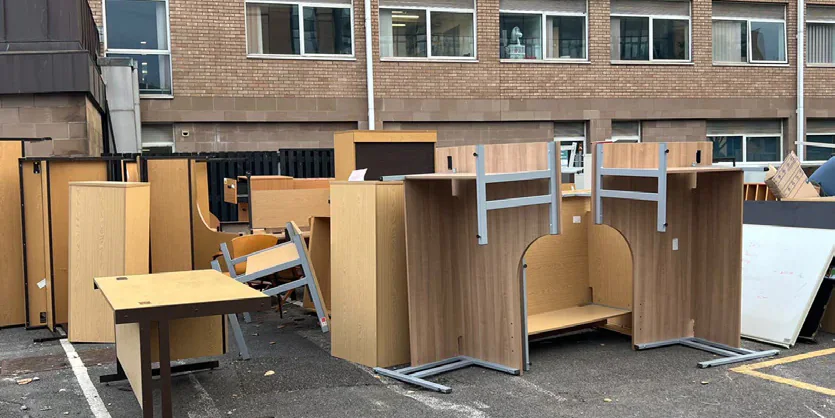
Additionally, multiple lecturers have commented on the wastefulness of these physical changes. Prof Ann Heilmann informed Gair Rhydd that “they threw out hundreds of armchairs [...] and bookcases”. Various other lecturers have been in touch with photographs of desks and other furniture left strewn on the street for weeks. One anonymous staff member commented that
"“the car park was full of [functional] furniture that was probably destined for the very big skips”, until 2026 Welcome Week,"
telling us that he and his colleagues “grabbed extra bookshelves before they sent them into the car park”.
Despite this, some lecturers commented that senior management allegedly marketed part of their motivation of moving all of Humanities into John Percival because “it’s good for the environment” and aligns with University attempts to lower their carbon footprint by reducing the amount of buildings they span.
Perhaps this visual clutter did not phase senior management, though, as they have not felt bothered to trek down to the Humanities buildings. One disgruntled School of Global Humanities lecturer revealed that, in a meeting between academic staff and senior management,
"Vice-Chancellor Wendy Larner allegedly “admitted that she hadn’t been to John Percival” until 2026 Welcome Week."
Despite Gair Rhydd finding last year that over £1m was spent in the refurbishment of the John Percival building,
"upper management does not deem it necessary to check in on the new restructuring"
and renovation. If they had, they might have also felt offended by the piles of furniture and books littering the car park.
An ‘Us and Them’ Mentality
These adversities combined have caused mounting frustrations and disenchantment with upper management. Despite this, academic and professional staff retain very strong trust in local management, immediate superiors and colleagues. One academic expressed that “one of the positive repercussions” of the cuts was that they have
"“never felt as connected with my colleagues than in this situation”."
While lecturers at other universities facing cuts, such as Nottingham and Exeter Universities, were split into groups of ‘at risk’ and ‘safe’, Cardiff University chose to put all staff at risk. As a result, a strong sense of togetherness was fostered among various hierarchies of staff who all felt equally unsafe, personally and financially.
An anonymous lecturer has suggested that moving the School of Global Humanities into, mostly, one base has been an “own goal” for management. One academic reported that staff “now have such a strong identity of us and them” which “is such a shame because we should be one university”. Yet, when
"“senior management gives the idea that they are one thing and we are another, that is so toxic”."
A dissatisfied Humanities academic certainly reflected this perspective, claiming that “they’ll try and suggest that they care, but you cannot believe a word that comes out of their mouths”. Speaking frankly, they feel “as soon as doors have been closed, they do not give a sh*t about us”.
Ultimately, they feel that there is a shared belief among staff that “nobody trusts” Wendy Larner, reflecting that “personally, [they] think she needs to go," and “somebody else [needs to] come and clear” Cardiff University up.
There seems to be a consensus, across the University, that if senior management continue to treat academic and professional staff in the manner they are now, a catastrophe could be on the horizon. As Dr Andy Williams put it, “The wheels are coming off, and nothing is being done”.
Therefore, potential industrial action could include strikes of ‘working to rule’, where professional and academic staff only work to their contracted hours. That could also include
"strikes from all professional work and assessment boycotts, which will substantially impact students' learning, assessments, and graduations."
Despite universal dread at the tremendous impact strikes and further industrial action would present to students, there is a resounding sentiment that upper management have faced staff with no other solution, making Industrial Action in 2027 highly possible and further trouble probable…
More photographs