
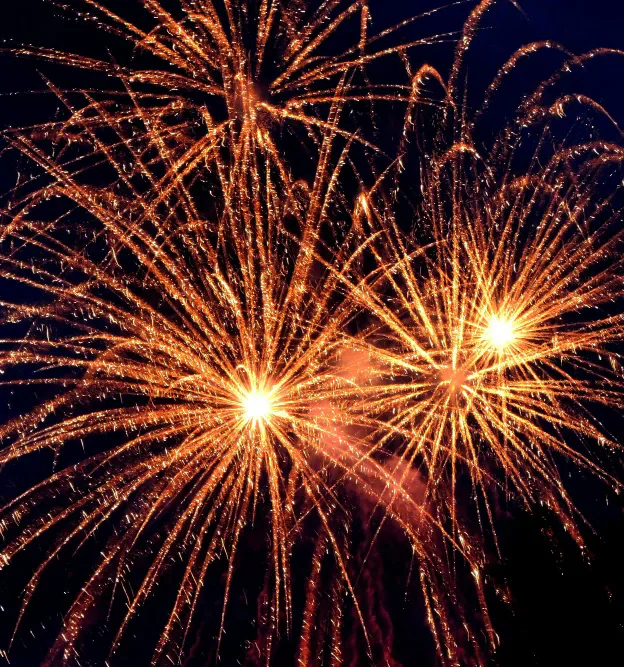
Many historians believe fireworks originated in the second century BC in Ancient Liuyang, China. Since then, they have become synonymous with grand displays and celebrations marking key events. You might even say we have a “particular proclivity for pyrotechnics” (RIP Dame Maggie Smith). What many people might not realise, however, is how exactly these explosives work.
Let us start with firecrackers, initially made from bamboo stems and gunpowder in Ancient China and constructed similarly today. Black powder (gunpowder) is enclosed in a narrow paper tube and a fuse to ignite the powder. But what exactly is gunpowder? It is a mixture of saltpetre (potassium nitrate), sulphur, and charcoal; aluminium may also be added to produce a brighter explosion.
On the contrary, sparklers—another common accompaniment to aerial fireworks—work somewhat differently. They are coated in a slurry mixture consisting of a fuel (typically charcoal and sulphur) and binder (sugar or starch) bound to the sparkler once the mixture dries. When lit, the sparkler burns, causing the oxidising agent potassium chlorate (a source of oxygen) to undergo a chemical reaction. It decomposes to yield potassium chloride and oxygen; the oxygen will then combine with the metal, allowing it to burn. This reaction is controlled as the fuel and oxidiser are balanced; hence, the sparkler does not explode! Furthermore, the bright sparks you may see are usually the burning of metal dust, such as aluminium, iron, steel, zinc or even magnesium, which all shine brightly at high temperatures.
Whilst this is an impressive feat of chemistry, the physics behind the more impressive displays of aerial fireworks is not to be taken for granted. Once the fuse is lit, heat energy travels along it until it reaches the bottom of the firework’s shell. The lift charge, also known as the bursting charge, which is made from black powder and situated at the shell’s undersurface, is ignited. When ignited, the black powder will undergo a reaction, creating a high volume of hot gases and a lot of energy. These combined forces cause the firework rocket to launch from its mortar, i.e. the tube it was secured to. Once the firework reaches a specific altitude predetermined by the length of a secondary timed fuse, it ignites and triggers a burst charge. Once activated, small spheres, cubes or cylinders of a sparklerlike composition—stars—explode into an epic display of vibrant colours, sounds and shapes.
Metal salts are responsible for the colours seen when a firework explodes. They are packed into star pellets within aerial shells, most frequently including strontium carbonate (red fireworks), calcium chloride (orange fireworks) and barium chloride (green fireworks). The arrangement of the pellets determines the aerial effects that paint the sky with intricate designs. To create a specific image, an outline of the figure is replicated inside the shell, surrounded by a layer of break charge, and additional explosive charges are placed inside the pellets to blow them outward into a more prominent figure. For example, a “willow” effect can be achieved when pyrotechnic stars (with a higher charcoal composition, which makes them longburning) fall in the shape of willow branches.