
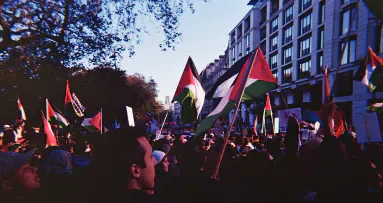
40 beheaded babies and several demonstrations across Britain during which hundreds of thousands of people “voiced their backing for Hamas”. Israelis being “killed” or “murdered” actively while Palestinians have “died” passively. Israeli hostages, including “children”, were exchanged with Palestinian prisoners, including “people aged 18 and younger”.
These are only some examples of unsubstantiated or misleading reports that have come out during the Israel-Hamas conflict from, what are meant to be, reliable and reputable Western mainstream media outlets with widespread, global reach. Many of the big names in mainstream media champion their “impartiality” and lack of bias in their guidelines. Yet there have now been too many occasions in which these same outlets have had to apologise for or walk back on their lack of impartiality in their representation of the conflict. “There are scores of international journalists in Israel who can cover every detail of every atrocity,” HA Hellyer, from the Royal United Services Institute, said. “But there is nothing of similar depth available when it comes to the incredible civilian catastrophe unfolding in Gaza”.
This has the effect of dehumanising Palestinians as nameless victims of a natural disaster. “Westerners are more immune to Palestinian civilian suffering than to Israeli suffering,” Hellyer said. The long displacement of the Palestinian nation since the 1948 Nakba; the occupation of the West Bank, which is carved up by illegal Israeli settlements and functions under a system of apartheid; and the blockade imposed on the Gaza strip since 2007, which many rights groups have referred to as the largest “open-air prison” in the world, is crucial context to the current conflict that has been missed out by the big outlets. Since October 7, Israel has been said to have violated a number of international laws with its “collective punishment” of Palestinians and its “total blockade” on Gaza.
This is not just the view of sympathetic activists, but the view of the United Nations, which is arguably one of the most important sources of international law, the World Health Organization (WHO) and several human rights groups such as Amnesty International. Journalists are trained to account for the fact that most people don’t read beyond the headlines or first paragraphs so the exclusion of such context is critical. How are normal people, like you and I, meant to achieve a holistic understanding of the current conflict without the context that predates it by decades and a simple understanding of international law?
And the journalists who want to speak out against their network’s pro-Israel bias fear losing their livelihoods and careers said Layla Maghribi, a British freelance journalist. Other journalists who are not reporting on the conflict have been fired for comments or actions that imply empathy with victims in Gaza. This atmosphere of intimidation against journalists and the failure of mainstream outlets to humanise Palestinians is causing the Arabic-speaking world and diaspora in the West to lose even more faith in the credibility of Western media coverage.
The distance, literally and figuratively, from the region should make readers question whether Western media coverage will give them the full story. When one is reporting from the safety of a London or New York office, how can an accurate, non-eurocentric representation of the Palestinian struggle be achieved? Perhaps this is why many have chosen to turn to non-Western media outlets; such as Al Jazeera, Middle East Eye and Haaretz; for coverage of the conflict.
It doesn’t help that many journalists in Gaza have been killed by Israel’s airstrikes and ground assault. At least 122 journalists and media workers have died since October 7, most of whom were Palestinians documenting what Western mainstream media has conveniently missed out of headlines. “CPJ emphasizes that journalists are civilians doing important work during times of crisis and must not be targeted by warring parties,” said Sherif Mansour, the Committee to Protect Journalists’ Middle East and North Africa program coordinator. “Journalists across the region re making great sacrifices to cover this heartbreaking conflict.” Does this all reveal a wider crisis in journalism? Are outlets willing to bend their impartiality rule when it comes to a certain part of the world but vehemently adhere to it when it comes to another?
Is it that for mainstream media, the West’s vested interests in Israel are more important than the freedom, self-determination and livelihood of Palestinians? “We’re not just witnessing a breakdown in humanity,” Layla Maghribi told Al Jazeera. “We are witnessing a breakdown in the profession.”