
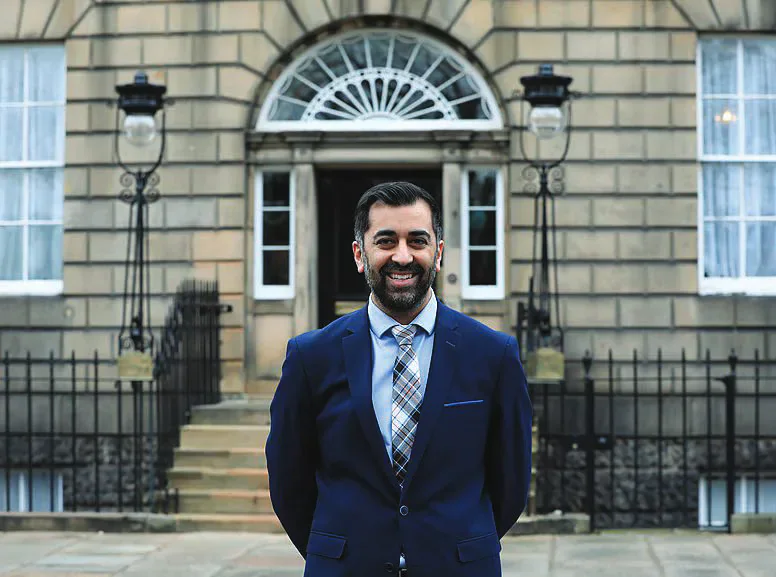
As the Green Party co-leaders Patrick Harvie and Lorna Slater departed Bute House on the morning of the 25th April, the Green Party–SNP coalition had reached its conclusion; with the split precipitating a brutal war of words against Humza Yousef; with Slater accusing Yousaf of “selling out future generations”, over the SNP’s announcement to scrap the now unreachable target of cutting greenhouse gas emissions by 75% by 2030.
Attacks on Yousef were not perpetrated exclusively by the Green Party when news broke of the split, with Douglas Ross of the Scottish Conservatives lodging a vote of no confidence and Anas Sarwar, Scottish Labour leader, accusing Yousaf of presiding over “failure and incompetency”, in his government.
As the political assaults continue, the question must be asked; what caused the decline and fall of Humza Yousaf?
Since taking the reins of First Minister, Yousaf and the SNP have been marred in controversy; be it the arrests of Nicola Sturgeon and her husband over the disappearing act of £666,955 of party funds that have led to accusations of fraud and embezzlement, to the errors in judgment of Humza Yousaf himself.
A recent example of this would be Yousaf’s meeting with Turkish President Recep Erdogan at the COP28 summit in December 2023.
The meeting raised issues for two reasons, the first being Erdogan’s categorisation of Hamas as a “group of freedom” and “warriors”, a mere 18 days after the October 7th atrocities; the second being that the meeting took place without any UK official present—a clear breach of ministerial protocol.
A month after the incident, Yousaf appeared to take aim at his own party, speaking of how he had “always been uncomfortable with the fact we had national in our name”.
It would not be a bold assertion to make that that a Scottish nationalist fearful of nationalism is not someone of much, if any, ideological coherence.
Not content with challenging the very premise of the party he leads, Yousef has since overseen the introduction of Hate Crime Act, criminalising the “intention to stir up hatred.”
Whilst attempting to clamp down on hate is admirable, given the 1,200% increase in antisemitism recorded in October 2023 from the previous year and the surge in Islamophobia seen in the past few months, the Act has faced significant backlash from lawyers.
Two outspoken critics have been Lorcan Price, an Irish barrister fearful of the “draconian” eff ects on freedom of speech the Act may have, and Helen Kendy KC, who has taken issue with the Act excluding women as a protected group.
The logistics of the Act have proved challenging, with the SNP’s effort to develop the required infrastructure admirable, if ever-so satirical; with hate-crime call centres set up in locations such as a Glaswegian sex shop.
Given Yousaf’s ability to aggrieve feminists, lawyers, diplomats, nationalists, and environmentalists, it is of little surprise his tenure as First Minister has proven so troublesome.