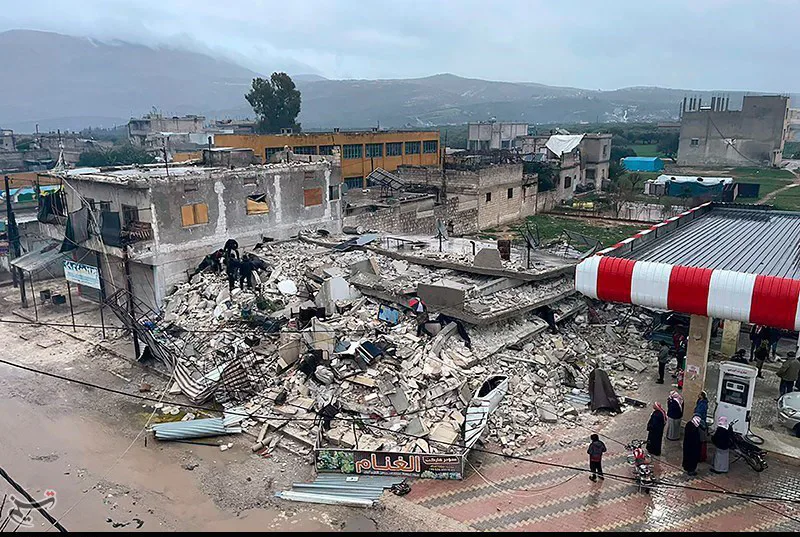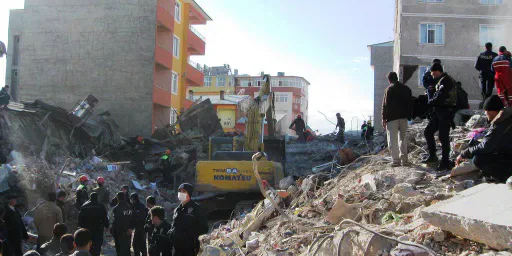
Ongoing rescue efforts to locate survivors trapped under the rubble remains of cities in Turkey and Syria are reaching exhaustion after days of searching following two earthquakes that have so far claimed the lives of over 25,000 people.
The quakes struck in the early hours of Monday, 6th February, along the East Anatolian fault near to the city of Gaziantep in Turkey. The first shock registered at 7.8 magnitude, followed by an aftershock of 7.6 magnitude just hours later. The temblors ripped across 31 miles in Southern Turkey and Northern Syria, extending to Syria’s second largest city Aleppo. More than 40 aftershocks have been felt since the initial quake with tremors being felt as far as Cyprus, Egypt and Lebanon.
The impact has been severe with the death toll exceeding 21,000 in Turkey, 3,500 in Syria. 80,000 are currently being treated in hospital while millions (1.05m for Turkey, 5.3m for Syria) have been left homeless.
Rescuers have been undeterred in their efforts to retrieve survivors since Monday with the dramatic scenes even being broadcast on Turkish television, providing much needed hope to the anxious population.
However, as the hours since the initial tremors continue to tick along, the chances of survival for those still entombed in the ruins are becoming slimmer. Experts say that barely 6% of earthquake victims survive if they have not been rescued within 5 days. This is in contrast to 74% after 24 hours. Victims and rescuers have also been competing with freezing weather conditions as a winter blizzard has covered major roads in snow and ice.
In Syria, the situation is exacerbated by the longstanding civil war that has hampered international rescue teams’ access to those requiring aid. Stéphane Dujarric, spokesperson for UN Secretary General, António Guterres, explained to the BBC that it is “hard to imagine a more complex emergency” in Syria.
Dujarric elaborates: “You’re dealing with a country that has been in conflict for 12 years, where already before this humanitarian emergency there was a long-standing humanitarian crisis with more than four million people needing aid.”
Aid to both Turkey and Syria has been arriving arduously to address the estimated 870,000 people who urgently need food and shelter. However it remains to be seen how the discrepancy in international favour between the two countries will translate into how much aid each receives as Syria remains under onerous Western sanctions. In an uncharacteristic move, the Syrian government, who have been internationally isolated for more than a decade, approved the delivery of humanitarian aid in cooperation with the UN, the International Committee of the Red Cross and the Syrian Arab Red Crescent.
The World Bank has pledged $1.78bn in aid to Turkey and The United States has offered an $85m (£70.6m) support package for those in need.
Turkey’s President Erdogan, calling the earthquake the “disaster of the century”, has vowed to take “every necessary step”, including the declaration of a state of emergency in ten provinces for three months.
However, criticism towards President Erdogan is also emerging over the government’s initial response and the lack of preparation for the catastrophe. The public has started to express frustration over shortcomings in the relief response, in particular around the state’s failure to coordinate with local authorities and relief agencies.
Another complaint lies in the apparent mishandling of funds taken through tax to prepare the country for an event like this. Following a similar earthquake in 1999, which claimed the lives of more than 17,000 people, the state introduced the “special communications tax”, which became known as the “earthquake tax”, initially intended to be a temporary fix to the economic losses but subsequently became permanent and understood to be put towards preparing the country for similar disasters in the future. The tax is estimated to have collected around 88 billion lira in total with the amount collected last year being the highest at 9.3 billion lira.
This catastrophe could pose the greatest political challenge President Erdogan has faced in his 20 year tenure. Elections are scheduled for just after the state of emergency is intended to end.
Turkey is one of the world’s most active earthquake zones with this latest episode echoing a quake of the same magnitude in 1939 which hit the east of the country and caused 30,000 deaths. Martin Griffiths, a United Nations emergency relief coordinator, speaking to Sky News, warned that the current death toll figure could double as more lives remain unaccounted for under the rubble.
The impact has been severe with the death toll exceeding 21,000 in Turkey, 3,500 in Syria.
In Syria, the situation is exacerbated by the longstanding civil war