
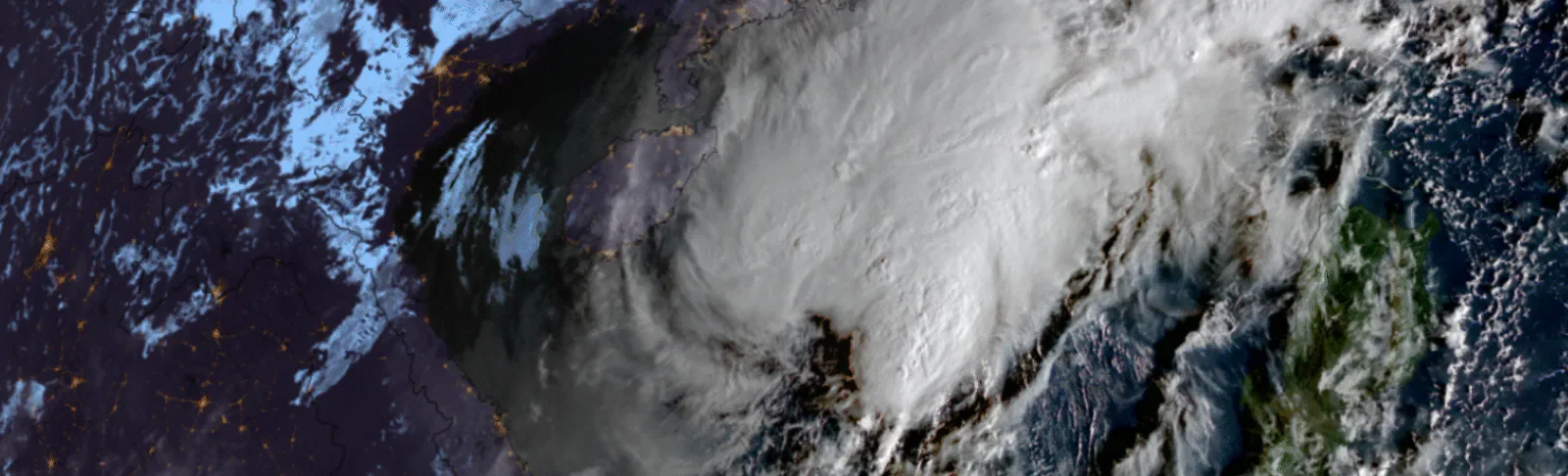
Typhoon Yagi, Wipha, Kajiki, Ragasa, Nongfa, Kalmaegi, Matmo, and Bualoi—just some of the typhoons that have ripped through Vietnam in the past two years and left severe flooding behind. These typhoons do not care about laws, urban planning, or infrastructure, but their wreckage reveals the deficits in all three. Vietnam experiences a lengthy typhoon season every year, with its long coastline, major river deltas, and tropical location providing prime conditions for typhoons to form.
While these storms are natural, the precipitously destructive flooding is a direct consequence of irresponsible sovereignty. As more of the country falls underwater, we need to call for action from political stakeholders and ask how much more damage to the infrastructure and economy the nation can take. Super Typhoon Yagi was the strongest storm to hit Vietnam in seven decades, making landfall in Quảng Ninh province and Hai Phong City on September 7, 2024.
Just a week after its arrival, more than 50,000 people were forced to evacuate, over 190,000 homes were flooded, and 329,000 structures were ravaged. Reports from the International Federation of Red Cross and Red Crescent Societies quoted 26 missing people and 325 deaths in Vietnam alone, with 844 total deaths across Vietnam, Myanmar, Laos, Thailand, and the Philippines. Việt Nam News reports the total economic damage caused by the typhoon at around 2.3 billion GBP (equivalent to 81 trillion VND).
Over 280,000 hectares of crops, fruit trees, and rice were submerged, with around 5.6 million livestock killed. This left devastating ramifications for communities that rely on their agricultural yields. The Ministry of Planning and Investment reported that in spite of “urgent and coordinated efforts from the entire political system [...] Typhoon Yagi caused extensive damage”.
Still, no amount of sandbags can cover up systemic and widespread infrastructure gaps. Despite learning from Yagi that Vietnam lacks the capacity to withstand natural disasters, especially as global warming intensifies wind speeds and rainfall, government officials made little to no effort to sanction tangible changes before the 2025 typhoon season. As of November 23, 2025, the death toll is again up to 90 and rising, with more than 12 people missing after days of heavy rain and landslides.
Typhoons Kalmaegi and Bualoi hit Vietnam within weeks of each other, overwhelming the sewage system and leaving relentless flooding, mirroring the wreckage of Yagi. 235,000 houses have been flooded, and 80,000 hectares of crops have been damaged. Water levels in the Ba River in Đắk Lắk province surpassed a 1993 record—the government estimating that the flooding has cost the economy over 260,000,000 GBP (9 trillion VND) in losses. Undoubtedly similar to the ruin caused by last year’s typhoon season, this raises the question of how the government has allowed this to happen again.
At a forum on “Smart, Sustainable, and Inclusive Development” held on November 5, Nguyen Duy Hung (Vice Chairman of the Central Policy and Strategy Commission) spoke on the failures of the government’s urban development process. He reasoned that the irreparable flooding was merely an outcome of infrastructure that had not kept pace with the rapid growth of urbanisation. In stark contrast, Antoine Mougenot, urban development specialist at the French Development Agency, revealed that many urban plans in Vietnam are based on outdated climate data.
This data no longer accurately reflects the extreme rainfall and rising sea levels. In the era of the Anthropocene—where human activity exacerbates, if not causes, climate disasters—it is imperative that the government, especially that of a country prone to typhoons, acknowledge the changing climate reality. Hung called for reform of the legal framework, including revision of laws that govern planning, infrastructure development, and integration of technology.
Simply changing the framework will not remedy the landscape and millions of lives that have been permanently affected. Risk identification must be at the forefront of reform, and the government cannot continue to ignore its direct complicity in this disaster. Between January and October of this year, the floods have resulted in 279 people dead or missing in Vietnam and caused more than 1.5 billion GBP in damage.
These people are not just bits of data to analyse as part of a larger statistic — it is 279 families, businesses, and communities that have been harmed by the failure of the Vietnamese government. How many more are going to die before the government decides to make a change?