
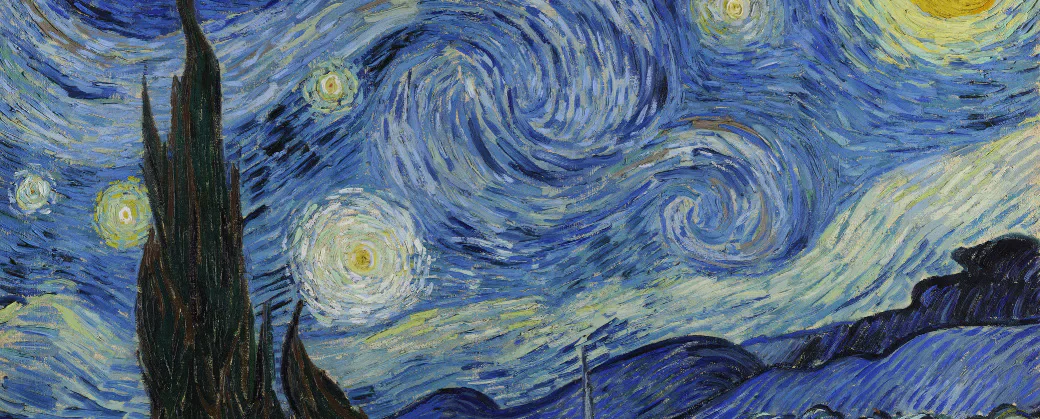
Vincent Van Gogh’s iconic painting The Starry Night has long captivated viewers with its swirling, turbulent sky and vibrant colours. The painting represents the view from his window in the south of France asylum he was staying in due to hallucinations from a severed part of his ear. Recent scientific research has revealed that this masterpiece demonstrates a surprising level of astronomical accuracy. Indeed, researchers have discovered that the swirling patterns, pulsing stars and bright moon in the painting align remarkably well with the principles of fluid dynamics, particularly turbulence in the atmosphere. The canvas’ fourteen main whirls in the sky closely follow Kolmogorov’s law of turbulence, a scientific theory that explains the distribution of energy in turbulent fluids.
These whirling shapes are more commonly known in the scientific world as eddies: big or small whirls that form with air when encountering, for instance, a solid object. A more common example of an eddy would be a swirl of air blowing around some leaves. Turbulent fluids and eddies have some distinctions: turbulent flows describe the overall chaotic state of air motion, while eddies are specific swirling structures that often occur within turbulent flow in the atmosphere.
Scientists analysed the relative scale, spacing, and brightness of the brushstrokes, finding that Van Gogh’s depiction accurately captures the rules behind atmospheric hidden turbulence. Specialists in fluid movements examined the artist’s brushwork by measuring the relative scale and spacing of the strokes and compared their size to the average scales expected from turbulence theories. Yongxiang Huang, a scholar of fluid dynamics at China’s Xiamen University, made these measurements and noticed that fourteen of the swirls align with Kolmogorov’s theory.
This alignment with Kolmogorov’s theory is noteworthy as it wasn’t formulated until decades after the painter’s death. His intuitive understanding of natural phenomena at multiple scales is truly fascinating, as his night sky corresponds to Bachelor’s scaling, which looks into energy fluctuations in small-scale turbulence. Most likely a coincidence, the intensity of yellow in his painting represents inertial energy in fluid dynamics—the force from the momentum of a flow. The brighter yellows in the art depict the stronger flows very well. The overall use of colour and brushstrokes create a dynamic and magical representation of the sky that aligns with real physical processes occurring in our atmosphere.
The twinkling of stars, known in science as stellar scintillation, is beautifully captured with straight brushstrokes around each orb. This pulsating effect, created by his use of different shades of colour in broken-up strokes, mirrors how turbulence in the atmosphere can cause stars to appear to twinkle. However, studies show that at the time of the creation of the painting, the moon would have been three-quarters full, and not a crescent like he represented.
While Van Gogh couldn’t have known about these scientific theories, researchers believe his accurate representation stems from careful observation of nature and an innate sense of capturing nature’s dynamism, such as the night sky. This demonstrates the potential for art to intuitively capture scientific theories before they are formally discovered.