
It was the perfect occasion, the perfect stadium. The Principality was rocking, and at the end Cardiff came out on top. 69–0. Revenge. Victory. What better way to do it than in the hallowed home of Welsh rugby, with the clear blue sky above and the chants and cheers of the crowd. The cacophony of noises that erupted whenever a huge tackle was made, a try was scored, or a conversion was missed deafened your ears, and put a huge smile on your face. It was not only a rugby match, it was an exhibition of a brilliant university rivalry.
But at the end of the day, we have to look at the real story—how on earth did Cardiff demolish Swansea and nil them?
Firstly, we have to look at Cardiff’s defence. Their use of a “blitz” style rush defence, which narrows down attacking options and forces play to the centre of the field, meant that Swansea could not make meters out wide. This left them scrapping and desperate for any kind of success and eventually led to pick and go charges at least 10 metres from the Cardiff try line. By repeatedly shutting down Swansea’s attack, Cardiff frustrated Swansea, and limited their options, often leading to either over- or undercooked kicks, some of which were far from thought out. Although a couple of the undercooked ones were retained, the positioning was awful and often led to a dominant tackle, putting Swansea on the backfoot. When Swansea had the ball, they had no ability to form a properly threatening attack. By the end, they looked lost. Possession was also highly limited for Swansea. This was not just because of Cardiff.
Swansea made a lot of mistakes, giving away eight penalties, eight knock-ons, and even kicked the ball dead into touch on kick-off.
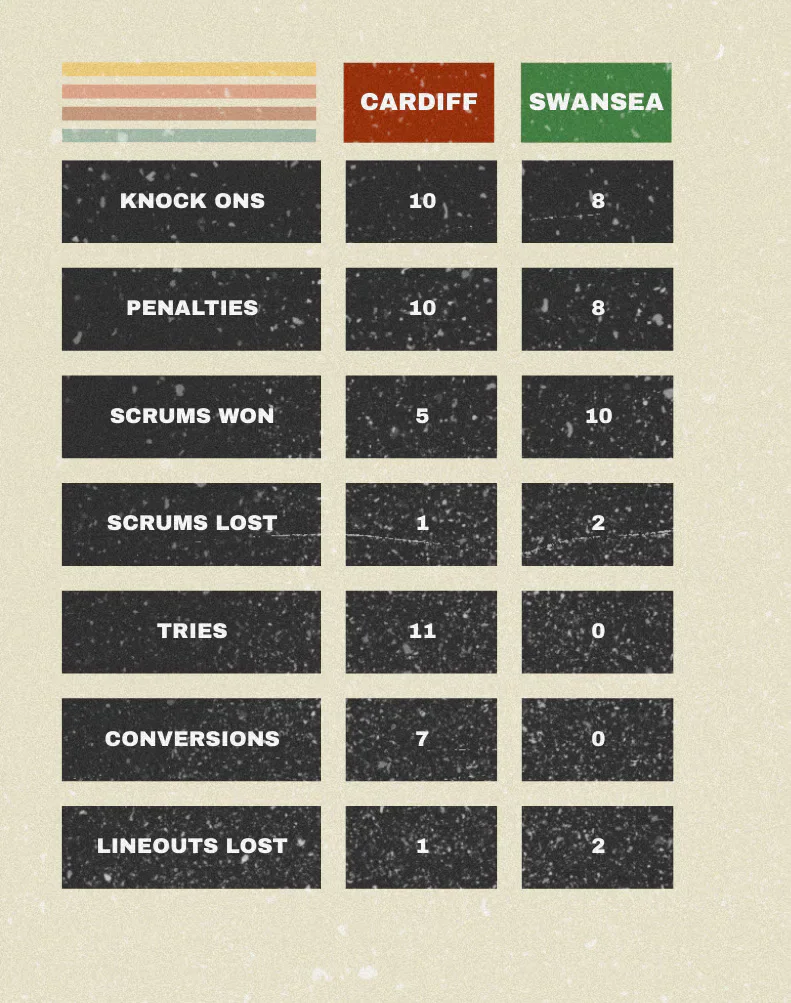
All this did was give Cardiff a huge attacking platform, and they took every opportunity they got. Stunning tries from MacDonald and Popple (who was announced as player of the match), in particular, boosted Cardiff’s spirit and showed how quickly they can turn defence into attack. When Cardiff held the ball and ran, as well as kicked tactically, they converted 90% of their opportunities. Antione Lere, the Cardiff fullback, who has just returned from injury, provided some excellent kicking behind Swansea’s line, pushing them onto the backfoot. After scrambling for the ball, Swansea often cleared poorly, allowing huge territory gains for Cardiff. Although Cardiff fumbled one lineout, the rest were consistent, and they stole a couple from Swansea, with one even leading to a try. When Swansea had an attacking maul on Cardiff’s 5-metre line, they were held up, and the maul failed. Their set piece, unlike last year, was abysmal. They gave away two scrum penalties and lost two of their own lineouts. All of this compounded in Swansea being unable to make any meters off the set piece, as well as costing them possession and stunting any attack. Both sides were scrappy at the rucks, with players holding on and shoving each other, but none of these events were penalised. However, both sides were far from well disciplined. Cardiff gave away eleven penalties, and Swansea conceded eight. Yet ill discipline did not cost Cardiff a single point. So how did they breeze past Swansea with such ease?
Cardiff capitalised on Swansea’s mistakes and thrived in broken play. Whenever the ball was loose, Cardiff managed to find a way through Swansea’s defences. They also targeted Swansea’s wingers, playing the ball wide and making huge territorial gains repeatedly. Swansea did well with some big hits to try subdue Cardiff, but it didn’t work. This was Swansea’s B side, as their A team was playing Brunel to stay in BUCS Super Rugby. But this B side looked out of place, and unaware of their shape and strengths. Cardiff were not perfect, but they capitalised on every opportunity, and Swansea failed to capitalise on anything. It was most certainly a day to forget for Swansea, but a day of absolute glory for Cardiff.
Archive note: The printed report says Cardiff conceded eleven penalties; the accompanying statistics graphic gives ten. Both are retained as printed.