
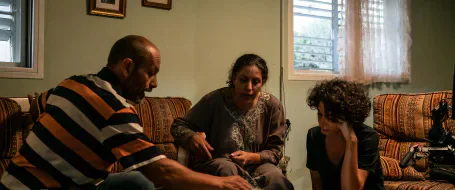
The Iris Prize is the largest LGBTQ+ short film prize in the world. Based in Cardiff, The Iris Prize awards £30,000 to the winner to make another LGBTQ+ film shot in Wales, which this year is awarded to Dima Hamdan, director of Blood Like Water. In the film, protagonist Shadi and his family are faced with an impossible decision: whether to collaborate with the Israeli police or a gay sexual blackmail video of Shadi will be sent to their community.
In 14 minutes and 24 seconds, Hamdan explores the complexities of loyalty, family relationships, and the understanding she shares for Palestinian families facing this horrible reality. I had the pleasure of speaking with her about all things Blood Like Water this week while interning with the Iris Prize LGBTQ+ Film Festival.
How do you hope that Blood Like Water will resonate with audiences? Particularly with audiences of different backgrounds than yourself?
To be honest, when I did the film, I had my audience in mind.
You know, I was thinking about a Palestinian audience, [...] your first audience always must be your local audience. If it resonates with them, it resonates with the world. I’ve seen so many times where films might be lacking in sincerity, and that’s because they’re contrived, they’re manufactured for a Western audience or a non-local audience.
So, a starting point always is my people in Palestine. Because, you know Blood Like Water is unlike any other film that I’ve done in the past, it is about tackling an issue. You know, the fact that this is based on true stories: gay Palestinian men are very vulnerable, and if they’re vulnerable, the entire society is vulnerable because they’re so easy to recruit.
I wanted to talk about that with a local audience, that was my starting point. [...] I didn’t set out to make an LGBTQ+ film, I wanted to make a film about choice. About the options that a family like Shadi’s has. It just happened to be that, in real life, this issue is the most difficult.
I wasn’t sure if I qualified as an LGBT film because, as an ally of the community but not from the community, and the question of representation, you’re never sure if that is the criteria. My friends told me: “No, it’s a very important thing, you have to show this on platforms.” Especially because there’s always this perception that Israel and Tel Aviv are the gay capitals of the world, the most tolerant place, gay pride in Israel is the most important event of the year, and people always celebrate that part. What they don’t realise is that they’re oppressing the gay community in Palestine, and to celebrate gay pride in Tel Aviv is pinkwashing the occupation.
So, this film must be seen by the community worldwide. So, I’m very excited to be at Iris.
What kind of questions and conversations are you hoping to provoke with the film? Do you think it’s relevant to broader LGBTQ discussions that are prevalent at the moment, or do you think it will provoke something new?
Well, as an ally of the community, I’m also an outsider.
So, if anything, this festival is going to be a huge education for me about what are the kinds of discussions, themes, topics, and issues. [...] Is [Blood Like Water] going to contribute to the wider discussion? I certainly hope so, I think it’s very important for me as a Palestinian that people realise that there’s a shared struggle against oppression, against these dark forces that are trying to wipe this side of existence, we’re not a conflict that is far away. This war has everything to do with the people here, especially in the UK because the government is complicit.
So, I’m sort of coming with my message, I want people to watch this and—it feels weird because, compared to all the other horrific scenes we’ve heard in the last year; the torture, the killing, the starvation, raping the inmates in jails. [...] I think I’m waiting for the screening to see how people react to it, and what kind of questions are going to be asked, I’m hoping that it will keep Palestine alive in people’s minds because when you’re into the genocide, we seem to not matter anymore.
And it was the anniversary [of the start of the war] yesterday, wasn’t it?
Yes, it was the anniversary. So I think it’s poignant that we’re coming to the theatre on the first anniversary to remind people, because right now, it’s impossible to isolate this issue from everything that is happening in Palestine, an entire nation is at risk, it’s not about—you know, how usually when they talk about a war or a conflict, and then they focus on women, children and the elderly, like “these are the most vulnerable” but in Palestine, everyone is vulnerable, everyone.
So, I think this is what I’m trying to remind people. If you think this is “outrageous”, keep it in mind, this is happening right now.
Would you say that at the heart of the film is the moral conflict or the political conflict?
It’s the moral conflict, the political conflict for me—I wasn’t interested in showing what the Israelis do.
It is very clearly targeting, there’s nothing there to explore, and the occupying of power anywhere in the world is going to look for the vulnerable, dark secrets and the poor segments of the people they are trying to control. [...] But I did it for my Palestinian audience, so I wasn’t interested in telling them “Look what the Israelis are doing”, they know what the Israelis are doing. For me, the bigger conflict is the moral issue, what does it mean to sacrifice, because you must understand that this is a very, very big deal. I mean, I come from a relatively conservative household, so I understand the notions of honour and reputation and all these things, these are very important values for my people.
So, I can’t jump over them and pretend that they’re not important, they are important, and this is where my starting point is. I wanted to make a film where the parents that are like Shadi’s parents can sit in
the theatre and feel that they’re seen and heard. [...] I wanted to create the fact that Shadi can feel for a moment that he can safely return home that night, and tell [his parents], halfway through the film. it tells you he becomes closer with his family. In most cases, the kids are not that close, they can’t come home and say to the parents what Shadi did with his parents. But I still want those parents to understand that this film understands their moral conflict, that it understands that this is a very, very big deal for them.
You can understand it from the father’s part in the film, where he says to his wife “Okay, even if I didn’t have a problem with him being gay”, which means “I do have a problem with him being gay, talk me through it, how am I supposed to protect him? When did the video come out?” So, I want the parents, when they see this film, to understand that this film is about them, to feel that they’re seen and that they’re heard. Which is to answer your question, it’s more about understanding the moral conflicts that these people face.
The film ends on a bit of a—I don’t want to say— cliffhanger, but you’re desperate to know what happens after [the blackmail film is released]. [...] Well, I think, when it comes out, in a situation like this, the Israelis will make an example out of this family. They will, the video will go viral, which is, I felt, rather than providing it as a clear answer, I was hoping to convey it in the sense of trepidation, the feel in the very last because they know it’s going to happen. Well, I completely forgot, we did have a ‘day after’ scene.
We shot it, but it didn’t work. What we had in the last scene was, it’s a beautiful morning the next day and the neighbour is walking down the street and she’s talking to her friend in a coded language to say that Gahed came, and she saw him, and she’s very happy. Then suddenly, she gets this disgusting video on her phone, and then you see all the neighbours are getting the video, and then you realise that the Israelis delivered on the threat.
We shot it, it didn’t look very good, and then when we watched it, we felt even if it worked well, it was not going to add anything. [...] It made sense to stop everything in the room, and then everything is this pressure-cooker situation. [...]
So, have you seen the reaction to the film in person before?
No, this will be the first time. Of the thirty-seven festivals, I only attended one festival in person, which was in Berlin. [...] And I wanted to apologise to [the audience]! Because I could hear sniffing in the theatre like people were crying. [...] I’m hoping that my film adds to the repertoire of [Iris’] films, that it’s something that hasn’t been done before.
You know, that would be a huge badge of honour, if somebody says to me “I’ve seen a lot of queer films, and yours is different”, it means I’ve contributed something.
Do you think that you’ll cover any similar subject matter again in future?
Well, Blood Like Water was taken out of a future project that I’ve been writing for many years [...] called Amnesia, and it talks about broader societal issues. It’s a crime thriller, like a political thriller of a guy who wakes up in the middle of the town of Jericho, in the middle of the night.
He’s got total amnesia, and then his journey to and through his memory reveals dark secrets about the town and amnesia becomes a metaphor for their collective amnesia. Then there is a mystery about a young man, and everybody knows his story but nobody ever talks about it. [...]
Do you have any plans for what you are making next, shorts-wise?
Well, I plan to shoot my first feature. [...] But I mean, to be very honest, I haven’t had a single creative thought since the war started.
I have not written a single thing; I have only managed to finish one book—I’m paralysed from inside. I just only started writing in my diary again. You know, Amnesia is on its way to being made because it has been written and rewritten and gone through multiple development labs before the war started.
I think I managed to finalise it and get one draft in at the beginning of the year, and I have not seen it since. Because if you asked me this question before the war, I would’ve said “I would love to forever make short films, whenever I can.” I don’t think I’ll ever have a career in filmmaking though. [...] I mean, I would like that, but I’ve been doing this for many, many, many years and projects always fall through, so I’m trying not to obsess over whether I’m going to have a career, and what defines a career. If I make 3 or 4 more films before I die, then that’ll be wonderful—but maybe not!
I do it because it saves my soul. And if it gets to a point where you’re in the industry and you feel drowned by the sickness that is in the industry and it’s no longer fun, then I don’t want to do it.
Is it important to you to tell stories that are close to home? What do you think about the debate regarding “who is qualified to tell which stories”? Do you think you can only tell stories that are within your sphere of knowledge?
Well, I certainly welcome the idea of making films that are not for my part of the world.
But I need to feel something for the story like it needs to touch me on a personal, visceral level. I mean, that’s who I am as a filmmaker, other people are more experimental; there are more poetic; and then their work transcends borders and transcends all these issues about conflicts and causes. I’m a different kind of filmmaker.
I feel that because I was a journalist, so I continue to approach things from a very factual perspective. So, I need to feel something that resonates with me. [...] Having said that, by the same token, I find it incredibly irritating when Western filmmakers come and decide they want to make films about our part of the world. That I think should be forbidden for a few years [...].
I feel like there’s a level of understanding that you can’t possibly grasp if you’re so far away. That’s quite a hot-button issue now, in the queer space and in the wider political space, of who can tell what story. This is why I was wondering, you know, like can I show, will my film be considered a queer film if I am not queer?
One friend of mine said to me, you know, she was quite adamant that I don’t qualify if I’m not from the community. Like I shouldn’t be speaking on behalf of the community. Or, you know, “Good on you, you’ve made a good film, but you don’t get to call it a queer film.” I was like “Ooh, okay. [Holding her hands up in surrender] Sorry!” And then multiple queer festivals were like “No, we want to have your film”. [...] I didn’t set out to make a queer film, I set out to make a film about something that resonated with me.
It took 2 years of talking to people and asking people. I did a development lab in Paris with Palestinian mentors, and they threw all sorts of tough questions at me, [...] They said “Are you making this because queer films are in vogue? Be honest.” I said “No, of course not,” and they said “Exactly.
So, if you know you’re not making it because—if you know for sure you’re not that kind of filmmaker, then what story are you telling? It’s a story about choice.” They were being tough for a reason, and I owe them a lot. Every element of Blood Like Water feels intentional to the viewer.
To me, Dima Hamdan was well deserving of the Iris Prize: they champion “excellence in storytelling”, and Hamdan exemplifies this in her film.