
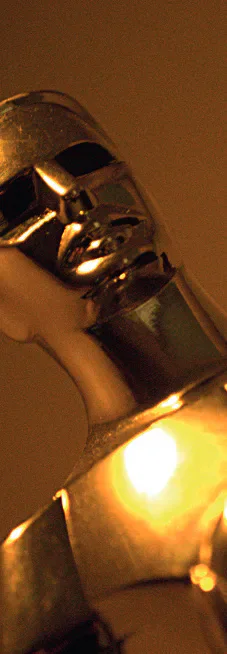
The 96th Academy Awards took place earlier this month in Hollywood, with 10 wildly different films battling for its coveted Best Picture award. This year’s nominations were punctuated with some of the best films of the century - let alone the year - with one of the most neck-a-neck Best Leading Actress categories of all time. Despite being the most prestigious filmmaking award ceremony in the world, The Oscars are no stranger to controversy, namely for their continuous lack of diversity amongst female and POC industry professionals.
The Academy has decided to combat these claims by nominating 3 entire female-directed films for Best Picture - which, before you turn your nose up at it, is a record-breaking amount. Before Parasite’s Best Picture win in 2019, a foreign-language film had never won the award. In 2024, however, there are three international films nominated.
Whilst it’s clear we have far to go when it comes to celebrating minorities within filmmaking, the baby steps taken by the Academy are hopefully indicative of change.
Without any further ado, here is your guide to the 96th Academy Award nominations for Best Picture:
Poor Things, dir. Yorgos Lanthimos: My personal favourite of the year, indie darling Lanthimos’ adaptation of the Alasdair Gray novel will undoubtedly be looked back on as a classic. Its brutal portrayal of sex and womanhood is shockingly graphic, yet depicted with a thoughtfulness that is often hard to find from a male director. A career-best from Emma Stone, it is impossible to tear your gaze from the enigmatic Bella Baxter, whose chaotic dialogue and physical acting are extremely worthy of her Best Leading Actress Oscar win. Mark Ruffalo gives surprisingly fantastic comic relief as Duncan Wedderburn: his scenes with Stone were the highlights of the film, with the pair creating a dance sequence so impeccable that I can’t think of a better-directed scene in recent years.
In many ways, Poor Things has elements of Fight Club (1999) in its irreverence and controversial nature; whilst not perfect in every sense, it is a generation-defining film that will be remembered for decades to come.
Killers of the Flower Moon, dir. Martin Scorsese: As mentioned in my previous review, this is Scorsese at his best.
After honing his craft for over 60 years, this 200-minute Western epic is a filmmaking triumph. Lily Gladstone shines as Mollie Burkhart, navigating rage and grief in a way that even manages to outshine Leonardo DiCaprio’s acting ability. It is a real shame that this film left the Oscars empty-handed, despite an impressive 10 nominations.
The passion put into this film is tangible - even featuring a cameo from Scorsese in its closing scene - making it an unmissable film that is, in my opinion, the magnum opus of one of the greatest filmmakers of all time.
Anatomy of a Fall, dir. Justine Triet: Winner of the Cannes Palme d’Or and the Oscar for Best Original Screenplay, this tri-lingual courtroom drama impressively manages to keep its intensity throughout its 150-minute runtime.
Sandra Hüller is incredible as its morally ambiguous protagonist, with equally fantastic performances from Swann Arlaud, Antoine Reinartz and newcomer Milo Machado Graner - who shows throughout an acting prowess well beyond his years. Anatomy of a Fall is a clean-cut, effortlessly engaging piece, propelled by an extremely talented cast and acerbic dialogue that transcends its language barrier. Although up against a selection of excellently written films (Past Lives and May December are masterclasses in screenwriting), its Best Original Screenplay win was extremely justified: it is one of the best-written films of this decade.
The Zone of Interest, dir. Jonathon Glazer: Unfortunately most famous for its controversial acceptance speech for the Best International Feature Oscar, The Zone of Interest is a subdued, impressionistic take on the Holocaust, showcasing the banality of evil in a series of drawn-out, aesthetically beautiful shots. A far cry from his previous work on lad-core thriller Sexy Beast (2000) and some of the most iconic music videos of all time (Jamiroquai’s ‘Virtual Insanity’, Blur’s ‘The Universal’ and Radiohead’s ‘Karma Police’ immediately spring to mind), Jonathan Glazer proves his ability as a genre-defying auteur.
Sandra Hüller once again steals the show with her acidic portrayal of a housewife desperate to keep up appearances whilst adjacent to Auschwitz-Birkenau. Thermal imaging is used to great unnerving effect, combined with a nightmarish score that encapsulates horror without overtly depicting it.
Past Lives, dir. Celine Song: An exploration of diaspora, lost love and regret, Past Lives spans the 24-year relationship between two childhood friends. It’s a yearning, heartfelt piece with expertly authentic dialogue from Song that instantly reminded me of Richard Linklater’s Before trilogy. Greta Lee plays the role of Nora perfectly: her chemistry with both Teo Yoo and John Magaro is palpable.
Despite its limited cast, Past Lives never fails to enthral its audience due to its incredibly impressive screenplay, which shows a maturity that is quite unexpected for a debut film. Simply put, Song is a writer and a director who is on the path to becoming one of the greats.
Barbie, dir. Greta Gerwig: A landmark of female-directed cinema as the first film directed by a woman to make over a billion dollars at the box office, it’s interesting to note that Gerwig did not receive a Best Director nomination for Barbie, with Margot Robbie’s performance as the titular lead also going unnoticed. This film is a testament to the ability women have to create meaningful, funny, well-made cinema; it’s incredibly cast, with a standout performance from Ryan Gosling, it’s aesthetically perfect, with impeccable set design and campy editing that makes the film a joy to watch. It’s also hilarious, with a surprisingly sardonic humour that captivates both the children and the adults in the audience. Billie Eilish’s now Oscar-winning contribution to the already iconic soundtrack makes for a thoughtful, necessary sequence on the importance of showcasing girlhood in cinema - it’s another modern classic and one of the most satisfying pieces of feminist cinema around.
Oppenheimer, dir. Christopher Nolan: Winning an astounding 7 Academy Awards, including Best Picture, Best Director and Best Actor, Oppenheimer is a 3-hour historical epic-turned-character-study that never wavers in its ability to engage.
Nolan is at this point a seasoned professional, and everything about Oppenheimer exudes professionalism; it’s masterfully edited, meticulously shot and well-acted in a way that can only be achieved by someone like Nolan. Although the writing is at best lacking and at worst cringe-worthy, its acting makes up for it - which of course it does, it contains one of the most impressive ensembles of all time. Cillian Murphy is a perfect fit for the titular role, with Robert Downey Jr. also offering a first-rate, Oscar-winning supporting performance.
American Fiction, dir. Cord Jefferson: The inclusion of this laugh-out-loud satire - and its Best Adapted Screenplay win - is a welcome one by the Academy, famed for its dismissal of black filmmakers. American Fiction is cynical and macabre in its humour, with an almost barely contained rage in its writing. It perfectly encapsulates the struggle of working within the media as a person of colour, with an intelligent and witty critique of a white-dominated industry through a variety of one-liners and cutaway gags (the “celebrating black voices” montage is one of the funniest sequences in recent memory). With standout performances from Jeffrey Wright and Sterling K. Brown, American Fiction manages to maintain its comedy whilst being an excellent portrayal of grief and strained family relations.
The Holdovers, dir. Alexander Payne: A simple but sweet Christmas dramedy, The Holdovers is a warmhearted romp with clear inspiration from John Hughes. Its cosy, ambient soundtrack propels the audience towards holiday feel-good, with a cast of intensely endearing characters that feel intensely genuine - mainly due to the great acting across the board. The most charming aspect of The Holdovers is its meticulously nostalgic cinematography and editing. With its brown-toned colour grading, Kubrick-style zooms and wipe transitions, the film easily absorbs you into vintage New England to the point it genuinely feels like it was made in the 70s. This film is at its best when it leans into drama; the emotional third act far outweighed the more lighthearted ones prior, but there’s a definite magic to The Holdovers that is hard to find in modern cinema.
Maestro, dir. Bradley Cooper: The most controversial choice by the Academy, this Spielberg-endorsed biopic documents the life of composer Leonard Bernstein and the turbulent relationship between him and his wife Kitty, played excellently by Carey Mulligan. Cooper has very publicly attempted to show his ability as an auteur with his sophomore film, utilising extreme method acting that comes across more as an obvious attempt at Oscar-baiting, as opposed to a necessary aspect of the film. Embarrassingly, despite the amount of press surrounding Cooper’s acting in Maestro, Mulligan manages to out-act Cooper in every scene they’re in together.
For reasons like this, I’m thankful it left the Oscars empty-handed. Don’t get me wrong, Maestro is not by any means a bad film - it’s just unfortunate that its release has coincided with some of the greatest films of the century. However, its inclusion in the Best Picture category does beg the question as to why it was chosen over a variety of stronger films; All of Us Strangers and Saltburn were some of my personal favourites from last year that have been all but ignored by the Academy, despite their wide critical acclaim.
This has been a truly magnificent year in filmmaking, and I can’t say I’d be disappointed at any of these films winning Best Picture (except maybe one). After several years of lacklustre box office success due to the pandemic, 2023 is a year of film that is indicative of cinema being back in full force, and better than ever.