
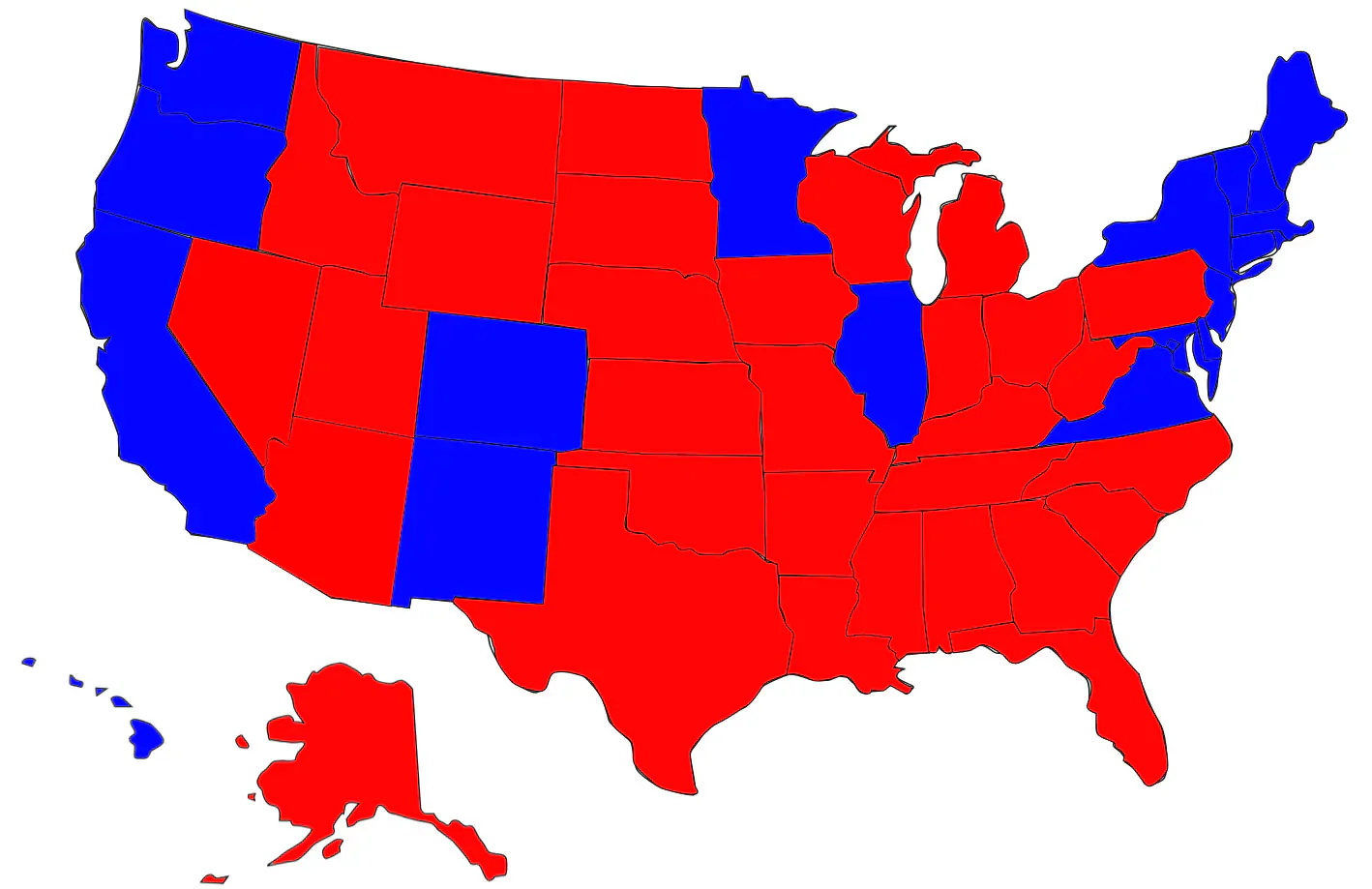
Presidential elections in the United States are not decided simply by who wins the most votes, unlike in many other countries. The US instead uses a system known as the Electoral College to determine who will become the president following an election. Under the Electoral College, voters technically do not vote for candidates, but instead for electors from their state who then ultimately elect a president and vice president on their behalf at a later date for a term of four years. Because of this, Donald Trump will not technically become the president until the Electoral College formally elects him and Congress meets to certify that election. It was this process that Donald Trump’s supporters disrupted when they stormed the Capitol Building on January 6th, 2021.
For a candidate to win the presidential election, they need 270 Electoral College votes, 50% +1 of the 538 up for grabs. Each state is given a number of Electoral College votes, calculated by its congressional representation, on top of three votes that are guaranteed regardless of the size of the state. This has resulted in voters in less populous states having disproportionate voting power in presidential elections.
For example, California, with a population of approximately 39 million people, currently has fifty-four electoral college votes—as it has fifty-two members of the House of Representatives. Wyoming, on the other hand, with a tiny population of only about 580,000 people, still has those guaranteed three electoral votes. This means that a voter in Wyoming has four times the voting power for picking electors for the College (and therefore, the outcome of the presidency) than a voter in California.
As the Electoral College decides who wins an election, and not the popular vote, it is therefore possible to become president despite receiving fewer votes than your opponent. This has happened five times in US history. Three times in the 19th century, once in the year 2000, and— most recently—in 2016, when Donald Trump won his first presidential term despite Democrat Hillary Clinton receiving 2.87 million more votes than him. Many political commentators were expecting a similar outcome in the 2024 election, prior to the extent of Trump’s crushing lead over Kamala Harris becoming evident.
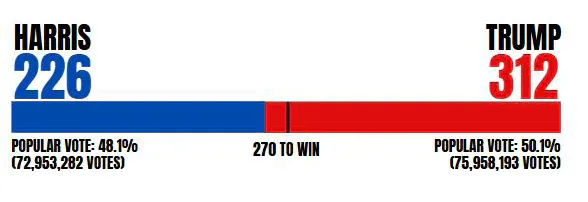
The ability for a candidate to win the presidency without the mandate of the masses is one of the main criticisms of the Electoral College. The other main criticism is that it makes most states worthless in a presidential election. Because most states are solidly Democraticor Republican-supporting, candidates know they do not need to campaign for votes in these states. It is the “swing states” (states who do not reliably vote for either party) which are truly up for grabs and ultimately decide elections. This is why so much attention is paid to these states by the media in the run-up to each presidential election. Supporters of the Electoral College argue that it was intended by the Founding Fathers of the United States to prevent the tyranny of the majority. In essence, it is intended to avoid larger states having too much influence over who becomes president and to stop people electing somebody unqualified to be president.
However controversial the Electoral College may be, it is incredibly unlikely to be abolished. Amending the US Constitution requires a supermajority (two-thirds of both chambers of Congress to vote in favour) and three-quarters of the states to ratify the amendment. In such a polarised America, this is virtually impossible to achieve.